
Consider These Habits to Build Mental Vitality in Strength
We live as if mental energy is limitless. But just like physical stamina, it drains—and in today’s age of digital overload, it drains faster than most of us realize. Endless meetings, nonstop notifications, and constant decisions chip away at our mental clarity until focus shrinks, creativity feels harder, and burnout creeps in.
This is the hidden cost of modern life. The solution isn’t just “mental health” in the traditional sense. What we really need is mental vitality—the brain’s version of fitness.
Mental vitality is what keeps your mind sharp, resilient, and energized. It’s not only about avoiding illness—it’s about building the clarity, adaptability, and energy that let you thrive. Just like physical fitness, it’s earned through intentional habits.
In a prior blog, we explored one key determinant of mental vitality: cultivating positive mindsets. Here, we turn to four other science-backed habits that boost mental performance, protect brain health, and build lasting resilience.
1. Focus Like A Laser
Focus isn’t just a productivity tool—it’s the gateway to meaning and momentum. When attention is scattered, energy leaks in every direction. But when it’s directed at a meaningful goal, it sharpens into power.
Think of the difference between a light bulb and a laser: both emit energy, but one diffuses while the other cuts with precision. Focus works the same way.
Deep focus can unlock flow states, those immersive moments where time disappears and you feel fully alive in the task at hand. Flow is one of the most energizing human experiences—and a cornerstone of mental vitality.
2. Rest Before You Break
Your brain often fatigues before your body does. Yet most of us miss the early signs: slower problem-solving, foggier memory, rising irritability. Push past those limits and productivity drops, along with creativity and resilience.
Like muscles, the brain functions best when it alternates between exertion and recovery. Strategic rest isn’t a luxury—it’s fuel. Short walks, stretching, music, or a few minutes of mindful breathing reset your brain’s circuits.
Instead of grinding through fatigue, these pauses restore clarity, improve decision-making, and sustain long-term mental energy.
3. Wander with Purpose
The mind wasn’t built for nonstop focus. Periods of non-focused thinking—like daydreaming, reflection, or open awareness—play a critical role in creativity, problem-solving, and emotional balance. These states activate the brain’s default mode network, helping you process emotions and connect ideas in ways deep focus cannot.
The risk is drifting into rumination or worry. But when guided intentionally—through a phone-free walk, unstructured journaling, or simply letting thoughts flow in the shower—wandering becomes fuel for fresh ideas, perspective, and resilience. It gives the mind space to recharge and often sparks insights you’d miss in focused work.
Done with purpose, mind wandering isn’t a distraction—it’s a hidden source of mental vitality.
4. Protect the Brain
Mental vitality isn’t only psychological; it’s biological. The brain is a living organ that thrives—or weakens—based on how you care for it.
Exercise strengthens key brain regions such as the hippocampus and prefrontal cortex, supporting memory, learning, and executive function. A nutrient-rich diet provides the building blocks and protective compounds that sustain optimal cognition. Sleep consolidates memories, restores mental function, and clears waste to safeguard long-term brain health
Neglecting these basics is like running a high-performance engine on fumes. Protecting brain health through lifestyle is the foundation of long-term vitality.
The Takeaway
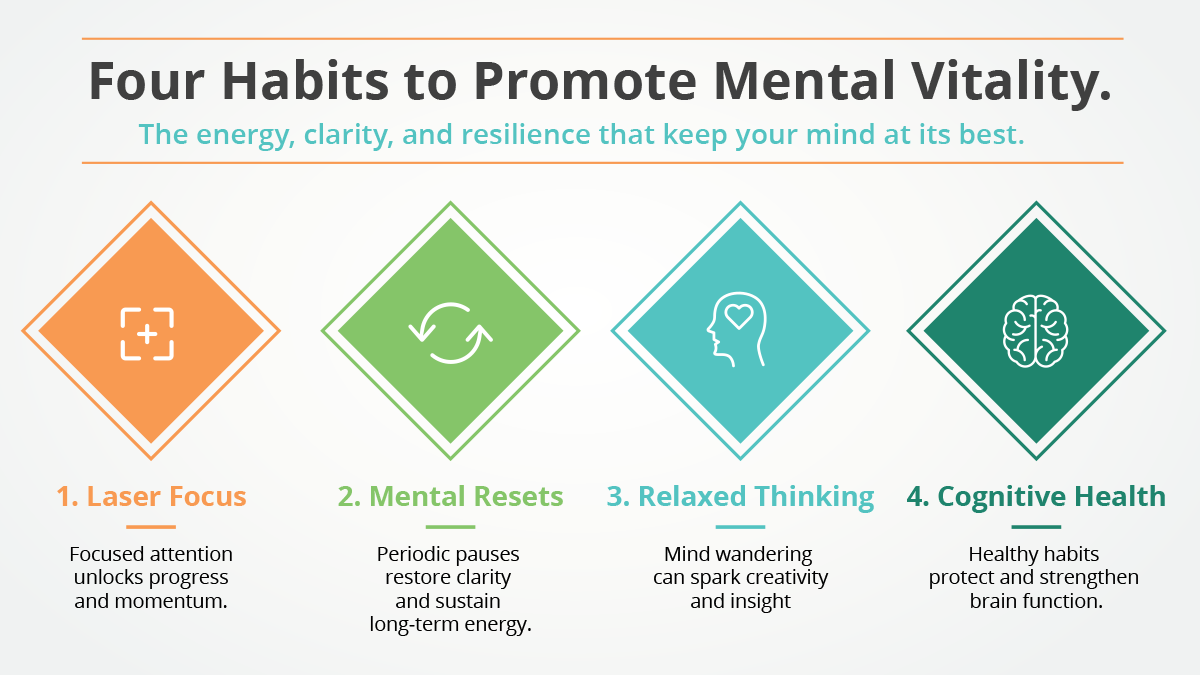
Mental vitality doesn’t just happen—it’s built. By focusing like a laser, resting before you break, wandering with purpose, and protecting your brain as the vital organ it is, you lay the foundation for a mind that’s not just free of distress, but fully alive.
In a world designed to drain attention and energy, these aren’t optional habits. They’re the pillars of mental clarity, creativity, and resilience.
And the good news? You can start today—with the next pause you take, the next moment of deep focus, or the next intentional walk without your phone.
In upcoming blogs, we’ll dive deeper into each of these four cognitive pillars of mental vitality so you can put them into practice and keep your mind at its best.