The Problem With a Word We Never Define
If healthcare isn’t primarily designed to build health, then the responsibility quietly shifts back to us. But that only works if we’re clear about what we’re trying to build. And that raises a basic problem: most of us have never really defined what “health” means in the first place.
We use the word constantly. We say we want to “be healthier.” We promise to “focus on our health.” Yet when you pause and ask what that actually looks like, the answers tend to be vague — decent lab results, a reasonable weight, going to the gym, not being sick. These aren’t definitions. They’re rough indicators.
Without realizing it, we end up pursuing numbers and appearances rather than the lived experience of feeling well. And when a goal is loosely defined, it’s easy to chase the wrong things.
Chasing Substitutes
I’ve seen this same pattern in another area of life: happiness.
Most of us say we want to be happy, yet few of us define what that means. And when a goal isn’t clearly defined, we tend to borrow society’s version — the right job, a higher income, a larger home, the next promotion.
Sometimes those things help. Often they don’t. Because achievement and happiness aren’t the same thing. One is external. The other is experiential. Without a clear definition, we chase what looks impressive rather than what actually feels fulfilling. We mistake the packaging for the outcome.
Health works the same way. When we don’t define it clearly, we gravitate toward substitutes — weight instead of energy, lab values instead of resilience, the absence of diagnosis instead of how well we’re actually functioning.
But numbers are only part of the picture.
What Health Actually Feels Like
Think about the days when you genuinely feel well — not just “not sick,” but truly well.
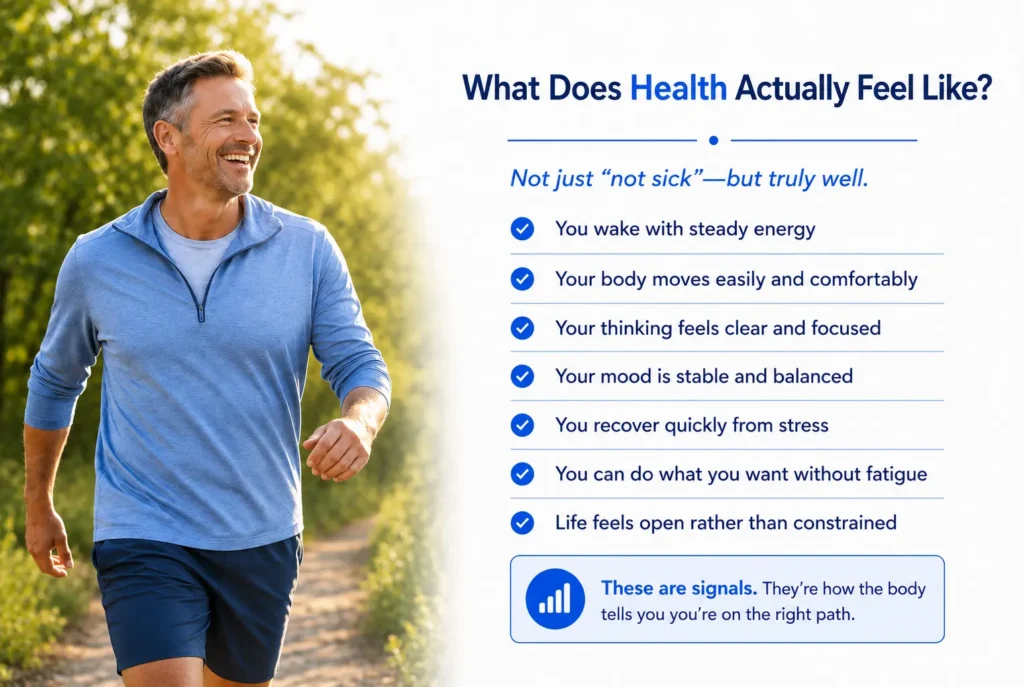
You wake with steady energy. Your body moves easily. Your thinking feels clear. Your mood is balanced. You recover from stress quickly. You can do what you want without fatigue or limitation creeping in. Life feels open rather than constrained.
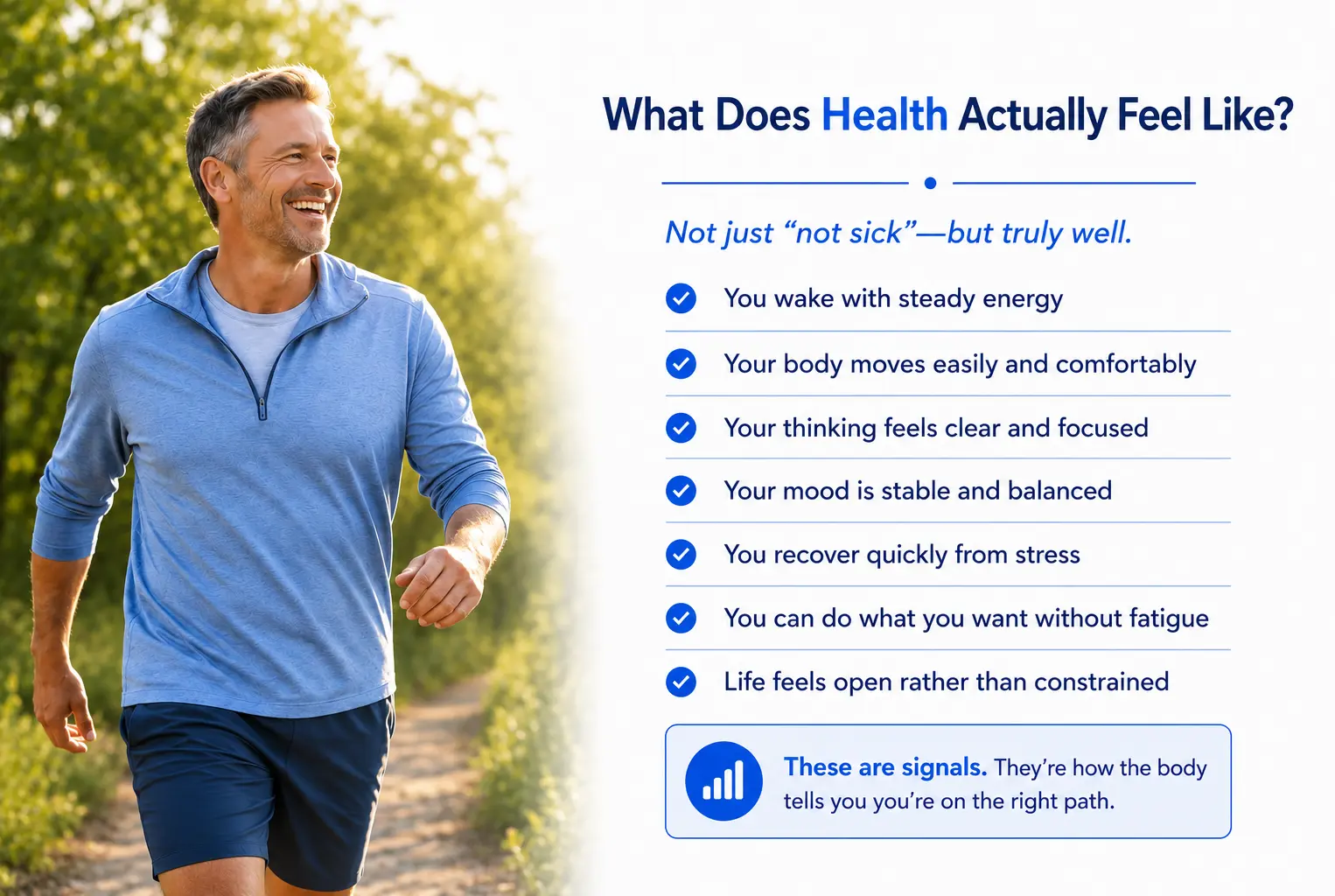
That’s what health feels like. And surprisingly little of it appears on a lab report. Your tests can be normal even as your sleep declines, your stamina fades, or your motivation weakens. When we define health only by what isn’t wrong, we overlook what’s quietly eroding — or what could be strengthened.
So this isn’t philosophical. It’s practical.
The way we define health determines what we pay attention to. If the definition is vague, our efforts become vague. But when we define health in terms of energy, strength, and daily functioning, our behavior naturally shifts toward building those qualities.
Why Clarity Changes Behavior
If health simply means “not sick,” it rarely occupies much space in our minds. As long as nothing hurts and no diagnosis appears, there seems to be nothing to do. Health remains in the background — something we assume is there rather than something we actively build.
But if health means having the energy, strength, clarity, and emotional steadiness to live fully, the strategy changes. Now the goal isn’t just to avoid illness; it’s to build capacity.
You walk because you feel better when you move. You protect sleep because it sharpens your thinking. You invest in relationships because they help you stay resilient. Health stops being a distant future concern and becomes something you influence every day.
That shift only happens when the goal itself is clear.
Where This Leads
Which brings us back to the question building throughout this series. If health isn’t merely the absence of disease, then what is it—in a way that’s practical and grounded in how the body actually works?
In the next essay, I’ll suggest that we may not need to define health in the usual way at all.
Instead, we can let the body do the defining for us.
Because over time, biology doesn’t argue—it reveals.
If we define health vaguely, we build it vaguely.