Let the Body Define Health
If we want a practical definition of health, we may not need to define it in the usual way at all.
We can let the body define it for us.
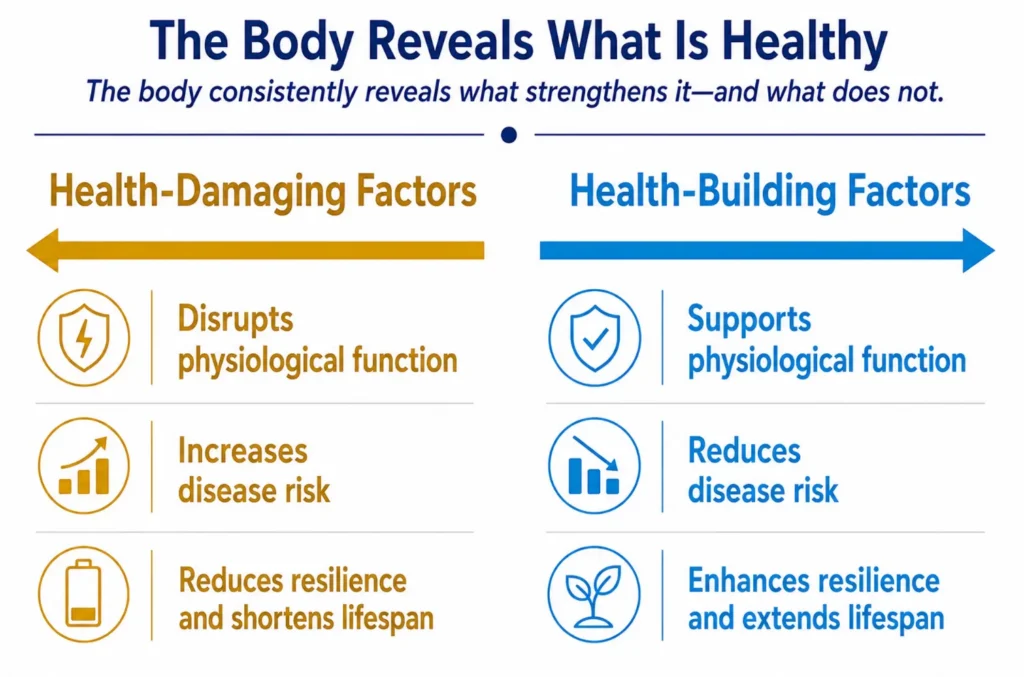
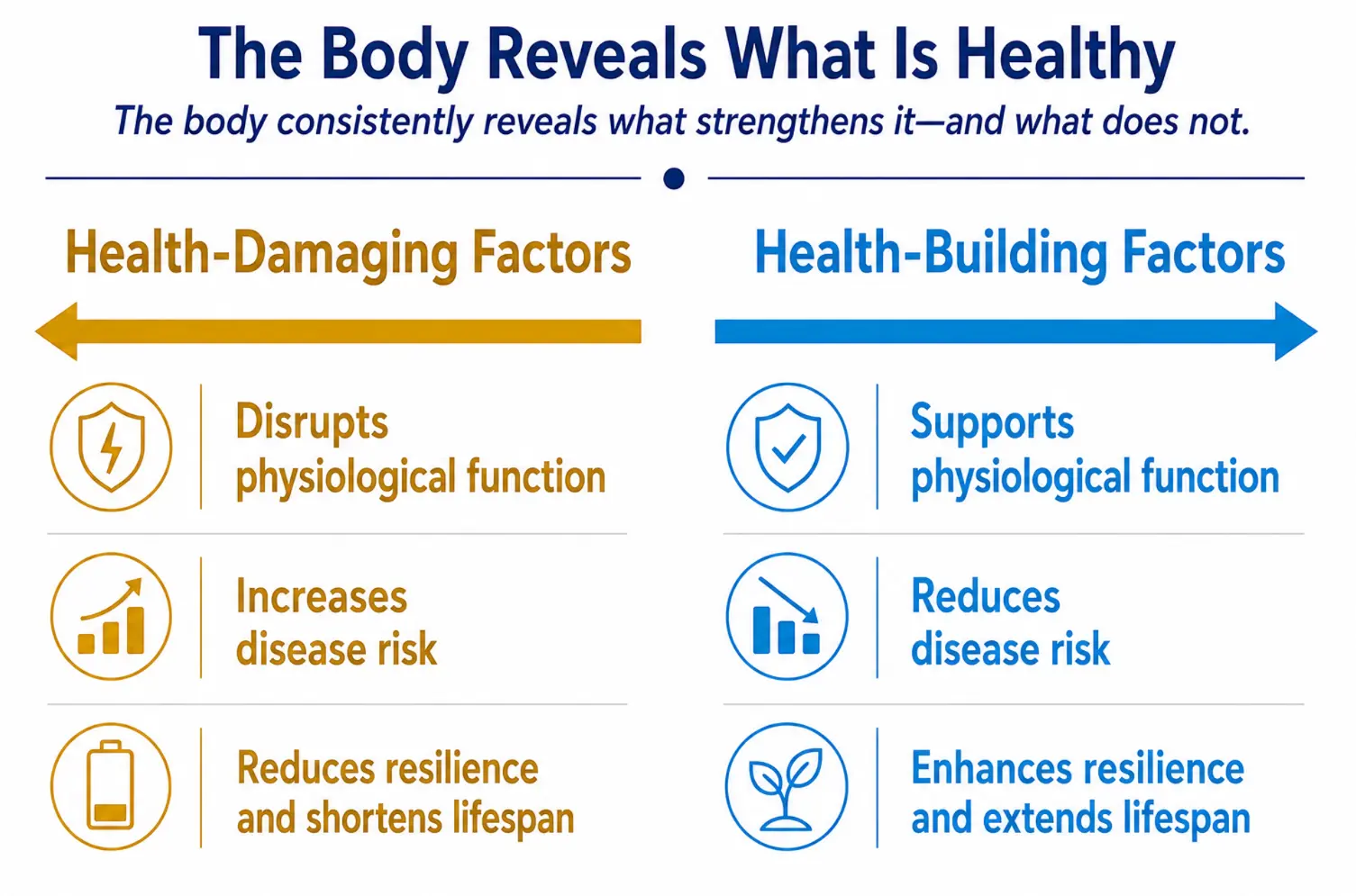
Over time, the body consistently reveals what strengthens it and what does not. Some influences improve its function, resilience, and longevity. Others quietly erode those same capacities.
In that sense, the body acts as a kind of signal — continuously reflecting the effects of how we live.
I didn’t arrive at this idea through theory. I arrived at it through people
A Fortuitous Detour
My pathway to understanding health didn’t begin with theory. It began with people.
While at Cedars-Sinai, I was introduced to Dr. Herbert Weiner, one of the pioneers of what was then called psychosomatic medicine — the study of how psychological and social experiences influence physical disease. At the time, this perspective sat at the margins of cardiology. We were trained to think in terms of arteries, plaques, and blood flow. Weiner saw something broader. He believed that life experience itself — stress, isolation, control, connection — could shape biology.
Through him, I was fortunate to receive a sabbatical fellowship with an interdisciplinary research network funded by the MacArthur Foundation. The Network was described as a “college without walls,” bringing together cardiologists, psychologists, neuroendocrinologists, epidemiologists, and social scientists to tackle a deceptively simple question: what drives behaviors and conditions that protect health, and what drives those that damage it?
For two years, I moved between campuses, collaborating with scientists who were mapping how lived experience becomes biology.
That period quietly changed how I thought about health.
When Experience Becomes Disease
Until then, like most physicians, I had thought about health almost entirely in physical terms. Cholesterol. Blood pressure. Plaque burden. Exercise capacity.
But the research I was seeing told a larger story.
Chronic stress altered hormone levels. Social isolation affected immune and inflammatory pathways. Depression predicted heart attacks and mortality as strongly as many traditional medical risk factors. These weren’t soft or abstract associations. They were measurable physiological effects.
Take depression as one example. Patients with significant depressive symptoms had roughly double the risk of developing coronary disease or dying after a cardiac event. The signal was strong and consistent across studies. Mood wasn’t just a feeling. It was influencing the heart.
That realization was hard to ignore.
If psychological and social experiences could disturb the body so profoundly, then health had to be broader than anything we measured on a standard lab panel.
Letting the Body Decide
Over time, a simple idea began to crystallize.
Instead of debating philosophically what health ought to mean, why not look at what the body itself shows us?
I began to think of the body as a kind of Geiger counter — an instrument that quietly detects what helps it and what harms it.
Certain influences reliably damage physiology. They increase inflammation, impair organs, accelerate disease, and shorten life. Others consistently protect and strengthen those same systems. These effects aren’t matters of opinion. They are visible in the biology.
Smoking is the clearest example. Its consequences are measurable and predictable: more cancer, more heart disease, more lung disease, shorter lives. No one debates whether smoking is unhealthy because the body’s response is unmistakable.
The same logic works in reverse. Regular movement improves cardiovascular and metabolic function. Strength training preserves muscle and independence. Restorative sleep stabilizes hormones and immunity. Supportive relationships buffer stress responses. A stable emotional life and a sense of purpose are linked to longer, healthier lives.
Across decades of research, the same pattern keeps appearing. Some factors consistently disturb physiology. Others consistently protect it.
The question isn’t whether the body gives us signals.
It’s whether we’ve learned to recognize them.
Simpler Way to Think About Health
This perspective changed something fundamental for me. Health stopped feeling abstract or philosophical. It stopped being a vague ideal or something defined only by the absence of disease. Instead, it became practical and observable.
Anything that reliably protects the body’s functioning, lowers disease risk, and supports long-term vitality is health-promoting. Anything that repeatedly damages those systems is not.
Seen this way, health isn’t a debate. It’s an evidence problem. We don’t have to guess. We can watch what the biology shows us.
And when you step back, these protective influences aren’t random. They cluster into a small number of recurring areas — patterns that show up again and again in the science of longevity and well-being.
In the next essay, I’ll lay out those areas clearly — the key domains through which our daily lives shape the body’s health and vitality.
Because once you can see where these influences live, the process of building health becomes far more intentional.
Health stops being something you hope for.
It becomes something you can deliberately create.
The body is already telling us what is healthy – if you know how to listen.