The Clues Are Already There
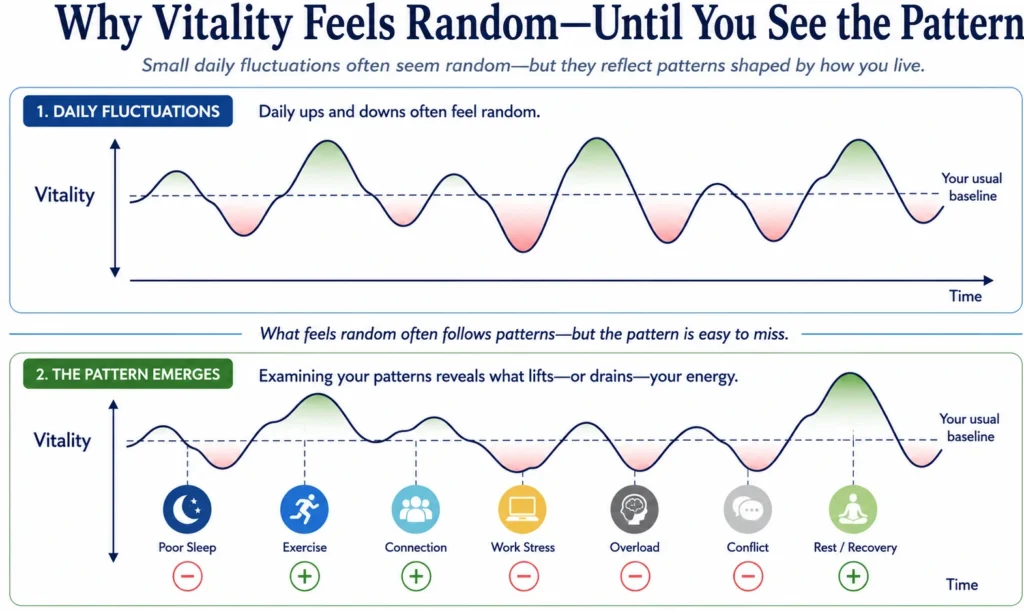
Once you begin to notice vitality, you realize it isn’t constant.
Some mornings you wake feeling clear and capable. Other days feel heavier from the start. Certain activities leave you energized, while others quietly drain you. Some conversations renew you, while others diminish you in ways that are harder to explain.
What feels random at first is anything but.
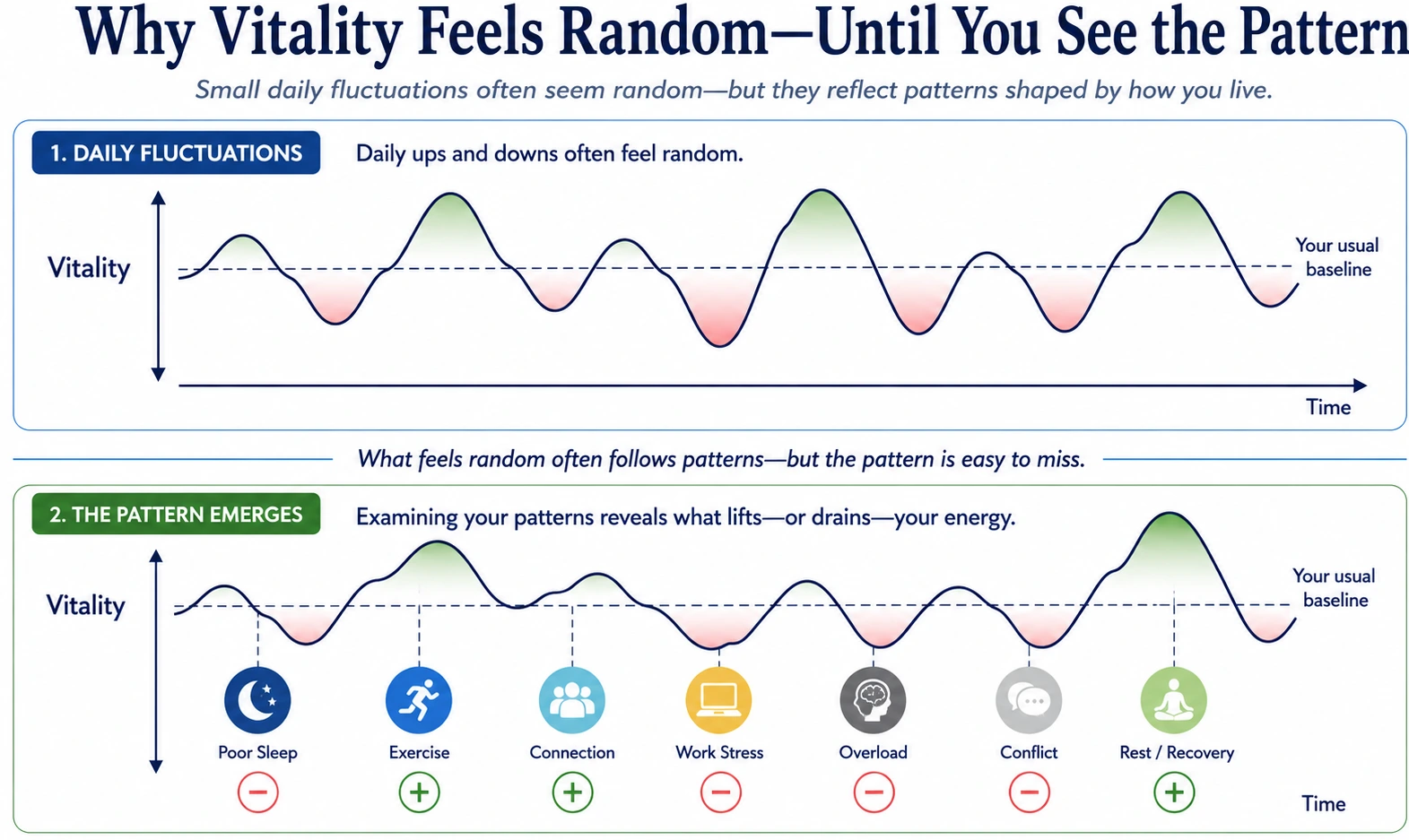
Vitality is constantly responding to how you live — to your sleep, your movement, your emotional life, your relationships, and your sense of purpose.
Most of us experience these shifts without examining them. We adapt to each day as it comes. But within these ordinary fluctuations are clues. Vitality is revealing what strengthens you and what diminishes you. Learning to recognize those patterns is the beginning of your Vitality Map.
When Vitality Fades Quietly
One of the challenges with vitality is that we tend to notice it most when it declines—and even then, the change is often subtle.
It rarely disappears all at once. Instead, it drifts. You may feel slightly less refreshed in the morning, a bit more reliant on caffeine, or a little less mentally sharp or emotionally engaged. These changes are easy to explain away—stress, aging, being busy. So we adapt.
And over time, something important happens:
Lower vitality begins to feel normal.
The Continuum We Rarely See
Vitality is not something you either have or do not have. It exists along a continuum, with high vitality—energy, clarity, resilience, and engagement—at one end, and fatigue at the other.
Most of life unfolds in between.
In this middle range, you continue to function. You meet your responsibilities. But the sense of ease is reduced, and tasks require more effort. You may rely more on stimulation or discipline to maintain the same level of performance.
Because these changes occur gradually, they rarely attract attention. What once would have felt like diminished vitality becomes everyday life.
Why Vitality Is So Easy to Miss
This creates a paradox: we are highly attuned to fatigue—but largely unaware of vitality.
Fatigue interrupts us and demands attention. Vitality does the opposite—it quietly enables everything we do. When vitality is high, you don’t think about it. You simply move through the day with clarity and ease, and because it feels natural, it becomes invisible.
Over time, this invisibility shifts your internal reference point. What once felt vibrant becomes something you no longer expect. The decline goes unnoticed—not because it isn’t happening, but because it happens gradually enough to be accepted.
The Signals We Overlook
Even after vitality declines, it still resurfaces. There are days when your energy unexpectedly returns, your thinking feels clearer, and you feel more like yourself again.
But we rarely stop to examine these moments. We experience them and move on, without asking why they occurred.
This is a missed opportunity. These experiences are not random—they are signals. They reveal your capacity for vitality and offer clues about the conditions that restore you.
Learning to See the Pattern
This is why awareness becomes so important. Before vitality can be strengthened, it must first be recognized.
When you begin to pay closer attention, patterns gradually emerge. You notice which nights of sleep leave you restored and which leave you depleted. You recognize how movement affects your energy, not just physically but mentally. You see more clearly how certain interactions leave you feeling connected and uplifted, while others quietly drain you. You become aware of how meaning, engagement, and emotional balance influence your sense of aliveness.
At first, these observations feel fragmented. But over time, connections begin to form. What once felt random begins to reveal structure.
A map begins to emerge.
The Vitality Map
Your Vitality Map is the personal pattern created by your daily experiences. It reflects the relationship between how you live and how you feel.
It shows you where your vitality is strengthened—and where it is diminished. It reveals which behaviors, environments, and relationships support your energy, and which quietly erode it.
As this map becomes clearer, something important changes: vitality no longer feels mysterious or beyond your influence. You begin to see that vitality is not simply something you possess or lack, but something that responds continuously to the conditions of your life.
Where Change Begins
This is where meaningful change starts—not with a program or a prescription, but with awareness.
When you recognize what restores your vitality, you begin to protect those experiences; when you recognize what diminishes it, you begin to reconsider the role those things play in your life.
At first, the changes are small—a different choice here, a subtle shift there—but they are no longer random. They are guided.
What once felt random begins to reveal direction – you are no longer reacting to your days, but learning how to read them.
What once felt like diminished vitality quietly becomes everyday life.