Early in my career, I set out to study a simple question: what actually stresses the heart?
My interest didn’t begin in psychology. It began with technology.
At the time, a new monitoring technique allowed us to record patients’ electrocardiograms continuously as they went about their normal daily lives. For the first time, we could see what the heart was doing outside the hospital — not just during treadmill tests or procedures, but during ordinary moments.
What we found surprised everyone.
Some patients with coronary artery disease were showing signs of reduced blood flow to the heart — what cardiologists call myocardial ischemia — while doing completely routine activities: driving, walking around the house, even sitting and talking.
They weren’t exercising.
They weren’t exerting themselves.
Yet their hearts were under stress.
That observation led me to a broader question:
Could something other than physical exertion be stressing the heart — and if so, what?
Testing the Hypothesis
To test this idea, I designed a study in our cardiac stress testing laboratory. We imaged patients’ hearts while they performed a series of mental tasks — including something as simple as talking about stressful experiences in their lives.
What we observed was striking.
In some patients with significant underlying coronary artery disease, merely speaking about emotionally stressful experiences triggered temporary abnormalities in the heart’s pumping motion — changes similar to those we often see during intense exercise testing.
That moment changed the trajectory of my career.
Until then, I had focused primarily on the mechanics of heart disease — plaques, arteries, blood flow. But now I couldn’t ignore what I was seeing: a powerful, measurable connection between the mind and the body.
That realization launched what has become more than four decades of work exploring how psychological and social factors influence cardiovascular health.
The Limits of the Disease Model
As it turned out, my timing was fortunate. By the late 1980s and early 1990s, a new discipline was emerging — soon called Behavioral Cardiology.
Study after study showed that depression, chronic anxiety, loneliness, and chronic unrelenting stress weren’t just “emotional issues.” They were bona fide cardiac risk factors, comparable in magnitude to many traditional medical risks.
From a medical standpoint, this fit neatly into the traditional model: identify what causes disease, then try to prevent or treat it.
So we studied the negative forces — the stressors, the risks, the things that break the system.
But something about that approach began to bother me. We were getting very good at identifying what makes people sick. Yet we weren’t asking the complementary question:
What actually builds health?
A Different Question
Around that time, chance intervened.
One day, browsing in a bookstore, a bright red cover caught my eye: The Healing Heart, by Norman Cousins. Cousins wasn’t a physician. He was a journalist and longtime editor of the Saturday Review, known for writing about the healing power of hope, laughter, and the human spirit. In the book, he described his own recovery from a severe heart attack using a self-designed program centered on positive emotions, engagement, and meaning.
It was an unusual story — almost radical by medical standards.
On the back cover, I noticed he had been appointed an adjunct professor at UCLA. My hospital, Cedars-Sinai, was affiliated with the university. On a whim, I made a phone call.
That call began an ongoing relationship and many long conversations. Cousins gently challenged many of my assumptions. He wasn’t focused on risk factors or disease mechanisms. He kept asking a different question:
Not “What causes illness?”
But “What helps people thrive?”
Slowly, an uncomfortable truth dawned on me.
I had become very skilled at understanding disease, but I wasn’t sure I knew how to define health.
The Blind Spot
That realization planted the seed for everything that followed.
Once I saw it, I began to notice something odd — not just in medicine, but in everyday life.
Even when we talk about “health,” we usually mean “not being sick.”
If nothing hurts, we assume we’re fine.
If the labs look normal, we relax.
We wait for problems before we pay attention.
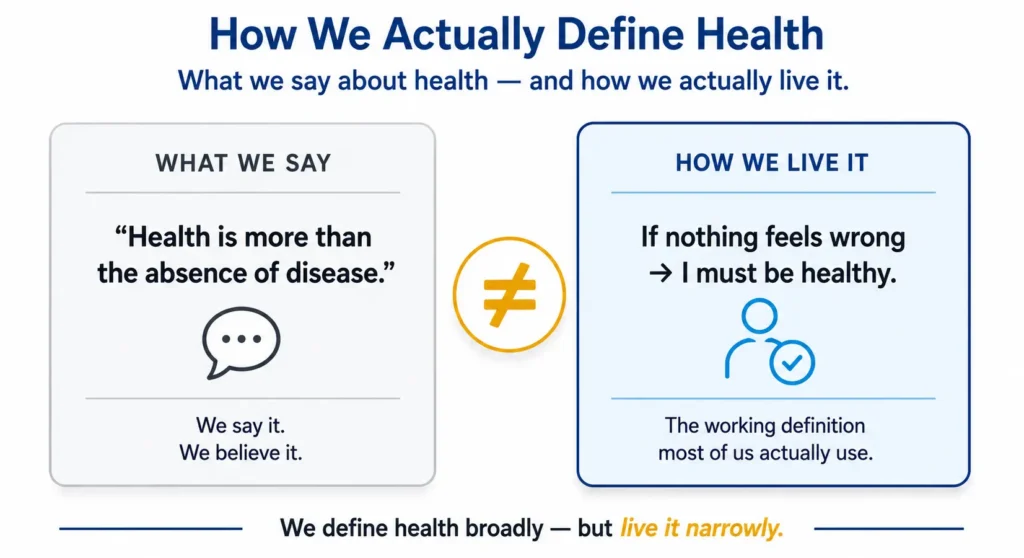
Intellectually, we say health is more than the absence of disease. But behaviorally? We live as if “no symptoms” means “healthy.”
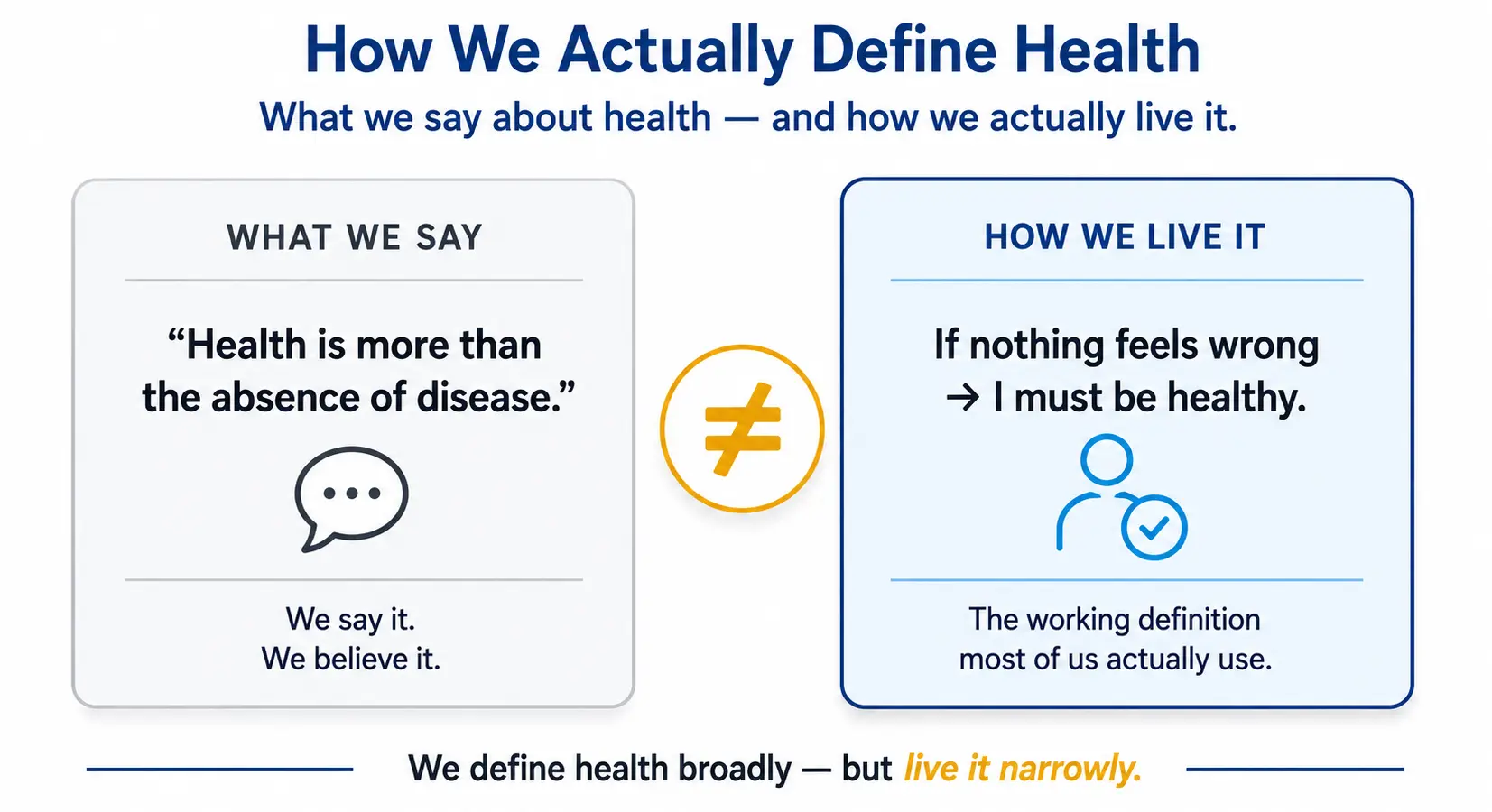
That quiet contradiction may be one of the biggest blind spots in modern health.
So it raises a simple question:
What, exactly, is health?
And why does defining it change everything?
I had become very skilled at understanding disease, but I wasn’t sure I knew how to define health.