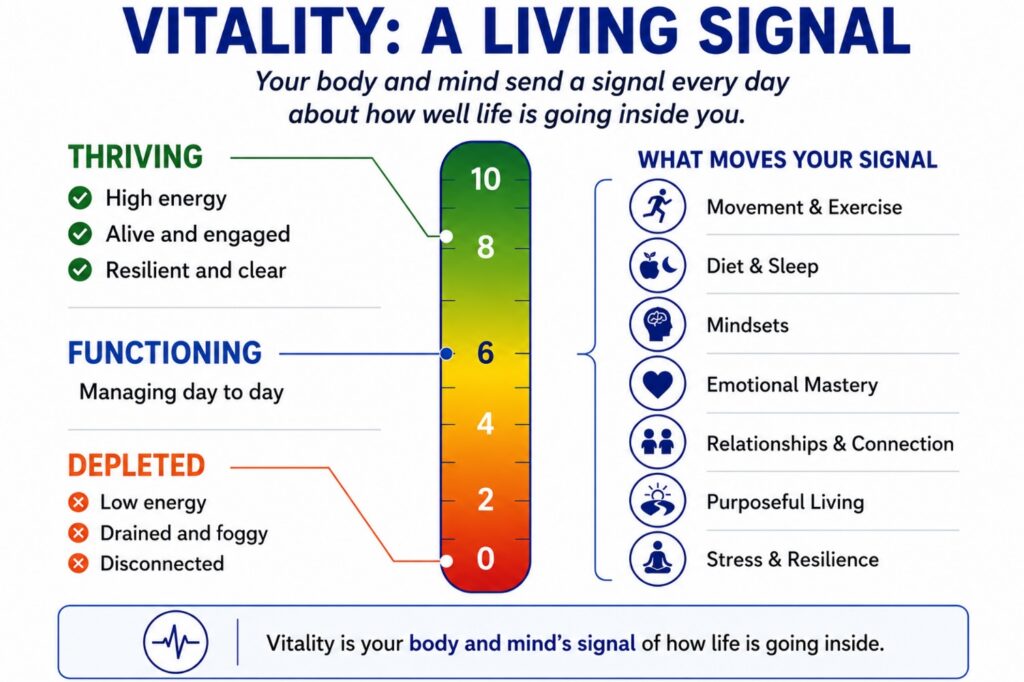
By this point, we’ve clarified something important: health is not simply the absence of disease, and it is continuously shaped by how we live.
But this creates a practical problem:
If health is being built or eroded every day, how do we recognize it as life unfolds?
We don’t feel our cholesterol. We don’t feel inflammation. And most of the processes that shape long-term health are invisible in real time.
Without a way to sense what is happening, we are left reacting late—after problems have already begun.
This is where a missing signal becomes essential.
In this pillar, we introduce vitality—not as a vague feeling, but as a practical, lived signal of how well your body and mind are functioning together.
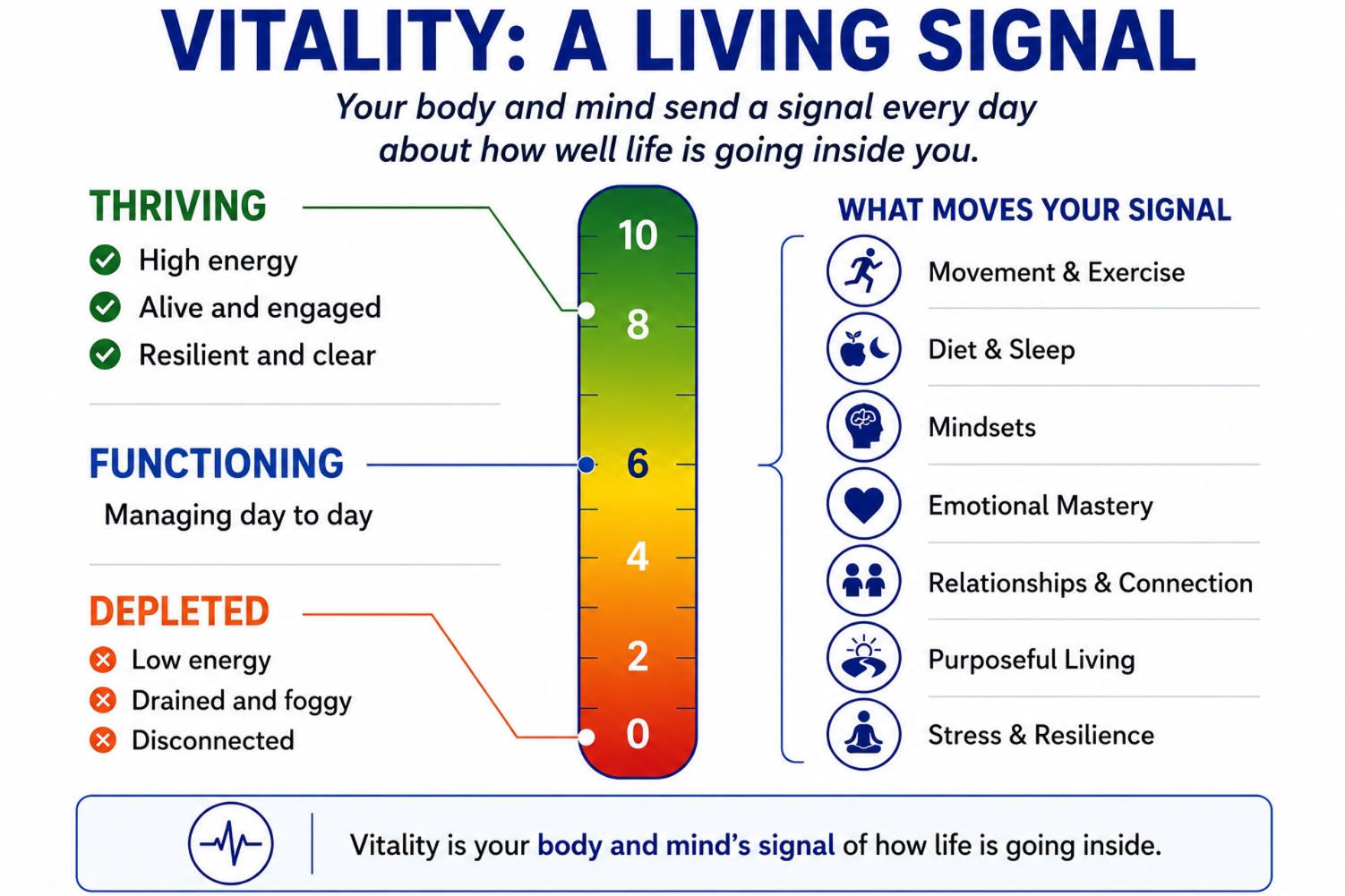
Vitality is the inner sense of feeling alive, energized, and capable. It is not excitement or adrenaline, but a steadier signal—the quiet feeling that your body and mind are functioning well together.
But vitality is more than a pleasant feeling.
It is a biological signal that reflects how the many dimensions of life—physical, emotional, and social—are registering within you.
Without a felt signal of health, we are left navigating blindly – relying on tests that often appear only after problems have begun.
In the next three essays, we explore how this signal works:
- The Shared Signature — why seemingly different influences like sleep, movement, relationships, and purpose all converge on a similar outcome: how alive you feel.
- Subjective Doesn’t Mean Unreliable — how researchers have shown that vitality is a measurable and meaningful indicator of health.
- The Vitality Question — a simple question about energy that can reveal imbalances long before disease appears on a medical test.
Once you begin paying attention to vitality, something subtle but powerful happens. Health stops being something you notice only when it disappears. It becomes something you can feel—and cultivate—every day.