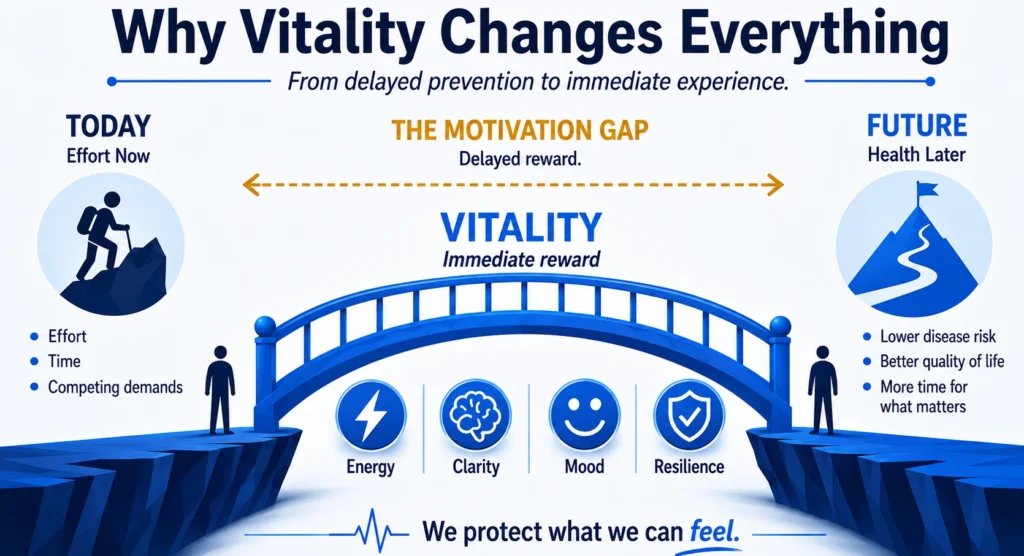
Up to this point, we have built the case for vitality as a reflection of health. The rise and fall of vitality reveal how the different domains of our lives—sleep, movement, relationships, stress, and purpose—are shaping our biology.
But recognizing vitality does more than help us understand health. It also helps explain why some health behaviors take hold while others repeatedly fail.
The answer lies in a simple but often overlooked reality: despite overwhelming scientific knowledge about how to protect our health, people often struggle to sustain the very behaviors that would benefit them most.
The Prevention Paradox
Most health advice asks us to do something difficult today for a benefit that may appear years—or even decades—later. Exercise to reduce the risk of heart disease. Eat well to prevent diabetes. Get enough sleep to protect your long-term health.
From a medical perspective, this logic is perfectly sound. Preventive behaviors reduce disease risk, extend longevity, and protect quality of life.
From a behavioral perspective, however, the equation is much harder to sustain. Human beings are not naturally wired to prioritize distant rewards over present experience. We respond far more strongly to what we can feel now than to what might happen years in the future.
When the reward for effort is delayed, motivation weakens – not because the goal is unimportant, but because it is psychologically distant.
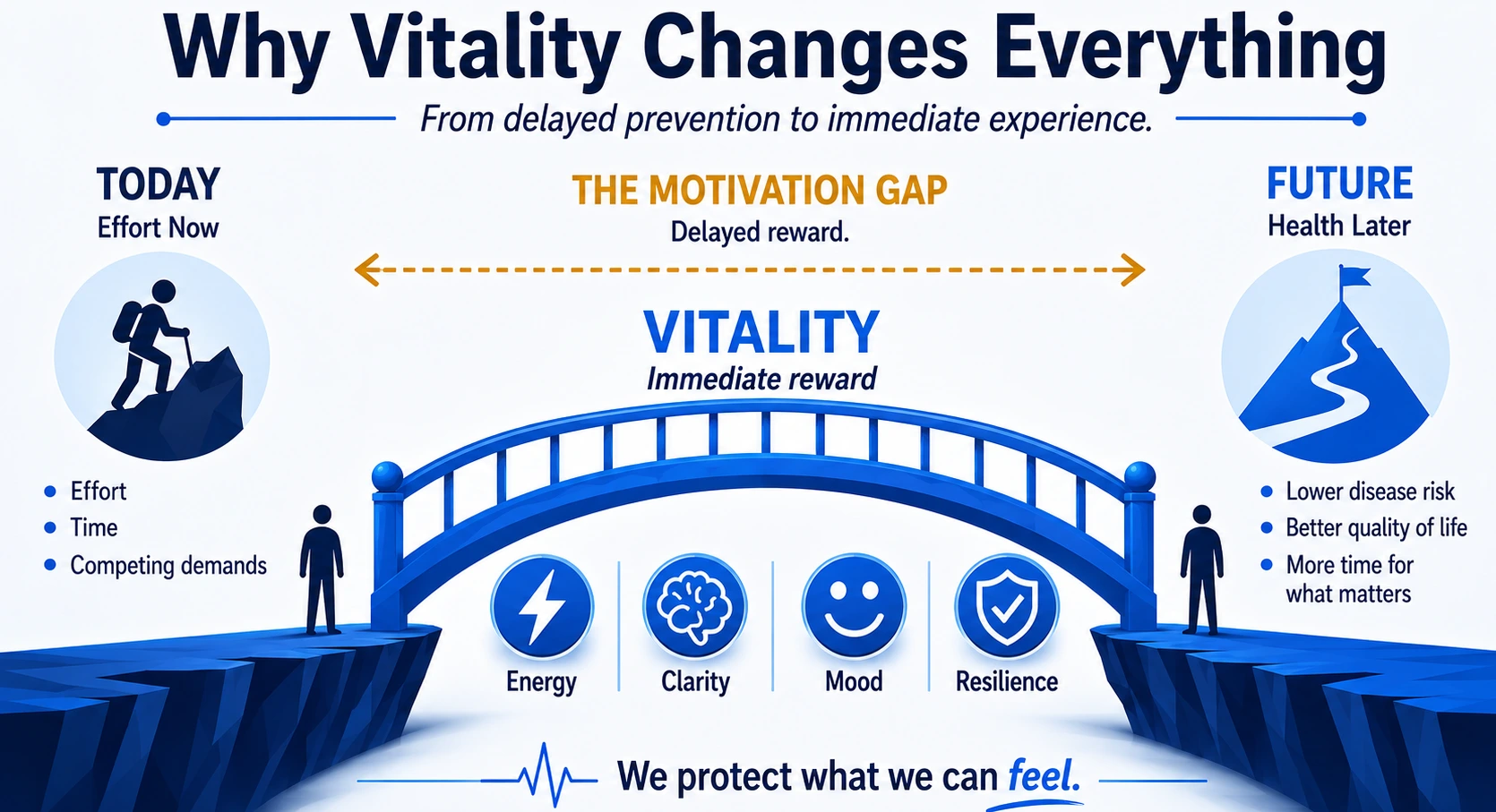
As a result, many health recommendations unintentionally create a motivational gap. The effort required today competes with pressures and pleasures that feel immediate, while the benefits remain abstract and far away.
Over time, the imbalance becomes difficult to sustain – and even well-intentioned goals begin to fade.
The Missing Incentive
Now consider what happens when vitality enters the picture.
Vitality is not a distant outcome that appears years later. It is an immediate experience—something we begin to feel within days or weeks as the conditions that support health improve.
Sleep becomes more restorative. Mornings feel easier. Movement generates energy rather than fatigue. Thinking becomes clearer. Mood becomes steadier. Engagement with life feels more natural.
These shifts may be subtle at first, but they are powerful because they are directly felt.
Instead of asking us to sacrifice today for a distant medical outcome, vitality introduces something very different: an immediate return on effort.
A Simple Example
Consider how physicians often talk about exercise.
We frequently explain that regular exercise lowers the risk of heart disease, diabetes, and premature death. All of this is true and scientifically well established.
But from a behavioral standpoint, those benefits can feel remote. A person sitting on the couch after a long day rarely finds motivation in the promise of reduced cardiovascular risk twenty years from now.
Within a few weeks of regular activity, however, many people begin noticing subtle but meaningful changes. Energy improves. Sleep deepens. Stress feels easier to manage. Mental clarity sharpens.
Exercise begins to feel less like a prescription and more like a source of vitality.
The motivation shifts from preventing disease someday to protecting how life feels today.
A Shift in Perspective
Once people begin to recognize vitality, their relationship with health often changes.
They are no longer pursuing an abstract goal of “being healthy someday.” Instead, they begin protecting something they can feel every day.
Energy becomes something worth preserving. Clarity becomes something worth nurturing. Emotional steadiness becomes something worth protecting. Behaviors that once felt like obligations begin to feel like investments in how life is experienced.
Health stops being a distant medical objective and becomes a lived experience.
Why Vitality Changes Everything
Prevention asks us to sacrifice today for tomorrow. Vitality rewards us today. When vitality rises, effort begins to feel different. Movement feels natural rather than forced. Engagement replaces fatigue. Behaviors that once required discipline begin to sustain themselves because they improve how life feels.
Instead of forcing ourselves to pursue distant health outcomes, we begin protecting something immediately valuable—the feeling of being alive, energized, and capable. And once that shift occurs, healthy living is no longer driven primarily by willpower. It is sustained by experience.
That is why vitality changes everything.
Prevention asks us to sacrifice today for tomorrow. Vitality rewards us today.