Using Energy as an Early Signal of Health
In the last essay, I suggested that vitality may be one of the most practical indicators of health we have.
That raises an obvious question:
Is it something we can actually use?
Over time, I’ve come to rely on vitality as a meaningful clinical signal—not as a replacement for traditional measures, but as something that often reveals what those measures miss.
An Unexpected Call
One evening, a close friend called me from Cleveland. He had recently undergone a cardiac evaluation for chest discomfort. The tests showed some coronary plaque — not severe enough for surgery, but enough to warrant tighter control of blood pressure, cholesterol, and lifestyle.
He asked if there was anything else he should be doing.
So I did what physicians are trained to do. I reviewed symptoms. Any shortness of breath? Fatigue? Dizziness? Decline in stamina?
“No,” he said. “I feel fine.”
On paper, nothing seemed actively wrong.
A Different Question
Near the end of the call, I asked something different.
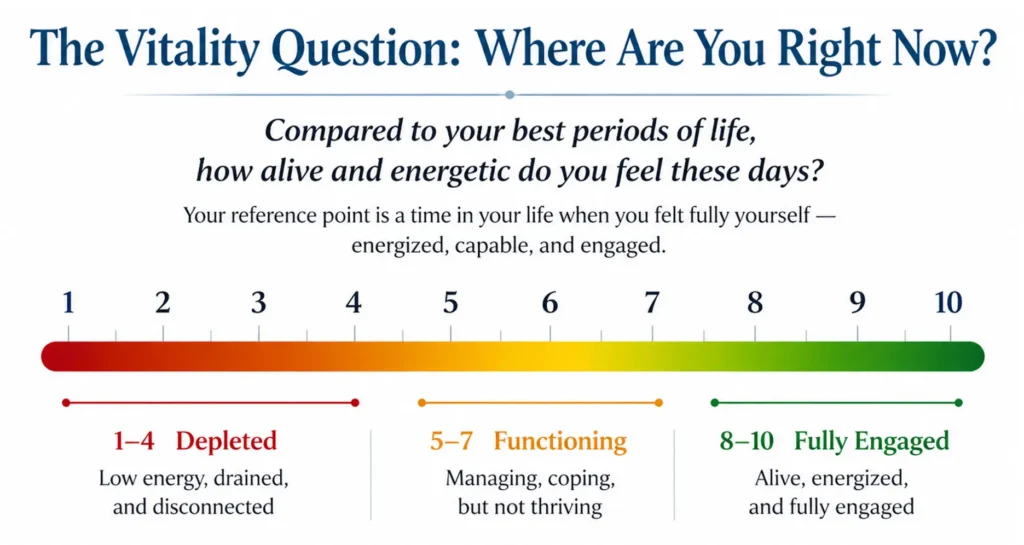
“On a scale from zero to ten,” I said, “where ten represents a time in your life when you felt truly energetic and fully yourself, where are you now?”
He paused.
“Probably a three.”
His answer surprised me.
Minutes earlier he had denied fatigue. Yet now he described himself as functioning at thirty percent of his usual energy. That gap told me more than any symptom checklist.
What Symptoms Miss
Medicine is highly effective at identifying disease. But the absence of disease is not the same as the presence of health.
Not being depressed is not the same as feeling joyful.
Not being exhausted is not the same as feeling energized.
Between illness and vitality lies a wide and often unrecognized middle ground—a place where many people function day to day, even as something essential has begun to fade.
My friend had fallen into that space. By conventional measures, he was “fine.” But by his own experience, he was no longer fully himself.
The Story Behind the Number
That single number—three out of ten—became the starting point for a deeper conversation.
What was draining my friend’s vitality?
As we talked, the real story emerged. My friend was locked in a prolonged and bitter business conflict with his sister. Every major decision in their jointly owned company had become a struggle. The tension had been building for years. He wasn’t physically tired, but he felt chronically frustrated, stuck, and emotionally drained.
Nothing would show up on a scan.
No lab would flag it.
Yet his system knew.
His vitality had dropped long before any new diagnosis appeared.
Vitality as Feedback
That conversation clarified something important. Vitality is not just a pleasant feeling—it is information.
When vitality is high, we tend to recover more easily, engage more naturally, and move through the day with a sense of momentum. When it is chronically low, something is often out of balance—sometimes physical, sometimes emotional, often both.
In this way, vitality functions as a form of early feedback. It reflects how our lives are registering within us, often before problems appear on a medical test.
The Vitality Question
You can apply the same question I asked my friend to yourself:
Compared to your best periods of life, how alive and energetic do you feel these days?
Most people can answer this almost immediately. Not because it is precise, but because it draws on a deeply familiar reference point—a time when they felt fully themselves: energized, capable, and engaged.
The answer is not a diagnosis. It is a signal.

From Signal to Awareness
Once you begin to notice vitality in this way, an important shift occurs.
You are no longer evaluating your health solely through external measures. You are beginning to pay attention to how your life is actually being experienced.
And that awareness changes the equation.
When vitality is high, effort feels natural. Healthy behaviors are easier to sustain.
When vitality is low, even small actions can feel like a burden.
In that sense, vitality does more than reflect health—it begins to shape it.
Where Change Begins
There is one final insight embedded in this question.
The number itself matters less than what it represents.
What matters is the distance between where you are now and where you have been at your best.
That gap is not a failure. It is information.
It points to the parts of life that may have drifted—and to the opportunities for change.
Because before we can build health, we need to learn to recognize where it is already rising—and where it is quietly fading.
And often, the first place we see that is not on a lab report or a scan.
It is in how alive we feel.
The absence of symptoms isn’t the same as the presence of health.