From Metaphor to Measurement
If vitality truly reflects what health feels like from the inside, an obvious question follows: is it simply a helpful metaphor, or is it something we can actually use?
It’s one thing to say that feeling energetic and engaged signals that the body is functioning well. It’s another to treat that feeling as a practical guide — something that can be defined, tracked, and strengthened over time. For vitality to serve as a meaningful indicator of health, it has to be more than poetic language. It has to be measurable and actionable.
In the 1990s, a group of researchers led by Richard Ryan and Richard Frederick began studying what they called subjective vitality, defining it as a “phenomenal nexus upon which physical and psychological factors converge” (1). Across their multiple studies, higher vitality was consistently associated with both psychological and physical well-being.
Their work gave language and structure to something I had been observing clinically for years.
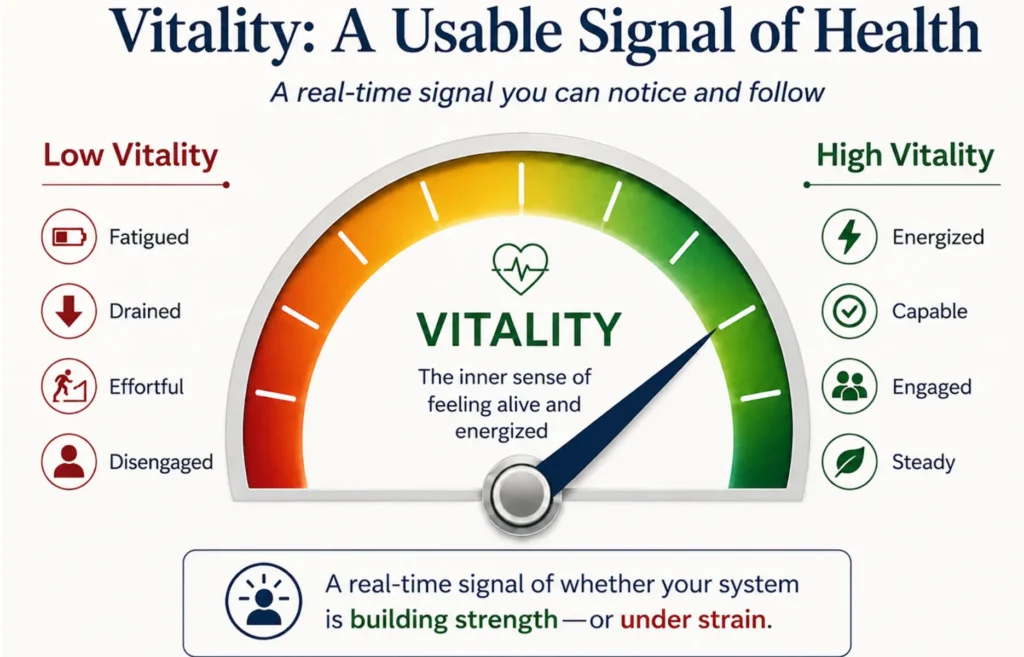
Today, I define vitality this way: vitality is the inner, pleasurable sense of feeling alive and energized — the kind of energy that naturally moves you toward action.
That definition sounds simple, but it captures something fundamental. Vitality feels good, alive, and forward-moving rather than heavy or depleted. It’s the difference between leaning into life and pulling away from it.
The Question of “Subjective”
At first glance, using something subjective as a guide to health may feel counterintuitive. Vitality isn’t a lab value or a scan or a number printed on a chart. We’re used to thinking of health in objective terms — blood pressure, cholesterol, glucose, imaging tests.
But step back for a moment.
In fact, the science linking these measures to biological outcomes is remarkably strong. Higher pessimism, chronic loneliness, and poorly regulated stress consistently predict greater risks of cardiovascular disease and earlier mortality, along with measurable disruptions in inflammation and metabolism. Conversely, optimism, social connection, a strong sense of purpose, and effective stress regulation are associated with healthier physiology, greater resilience, and longer life.
Similar patterns extend across the emotional spectrum. Depression is strongly associated with higher rates of cardiovascular disease and mortality, while positive states such as happiness are linked to better health outcomes and greater longevity.
Subjective does not mean vague or unreliable. It simply means the signal comes from lived experience rather than a laboratory instrument alone.
If vitality is a valid signal, the next question is what exactly it reflects – and how to interpret it correctly.
A Subtle Distinction
There’s an important distinction here. Vitality isn’t the same as raw physical energy. Aging changes capacity. But vitality is less about capacity and more about how alive and engaged you feel.
A person can have reduced physical capacity and yet still feel deeply engaged and alive – or have high capacity but feel flat and depleted.
That difference is easy to miss – and it shapes how we interpret the signal of vitality.
Your Reference Point
There’s another reason vitality is so useful. It isn’t an abstract concept that requires a device to measure. Most of us already know exactly what it feels like.
Think back to a period in your life — not just a good day, but a stretch of weeks or months — when you felt buoyant, capable, and fully yourself. When getting through the day felt natural rather than effortful. When you moved through life with momentum.
That memory is your reference point. It reminds you what “well” actually feels like. And it tells you that vitality isn’t theoretical — it’s something you’ve experienced before, and something you can rebuild.
A Practical Indicator
Seen this way, vitality becomes more than a feeling — it becomes feedback.
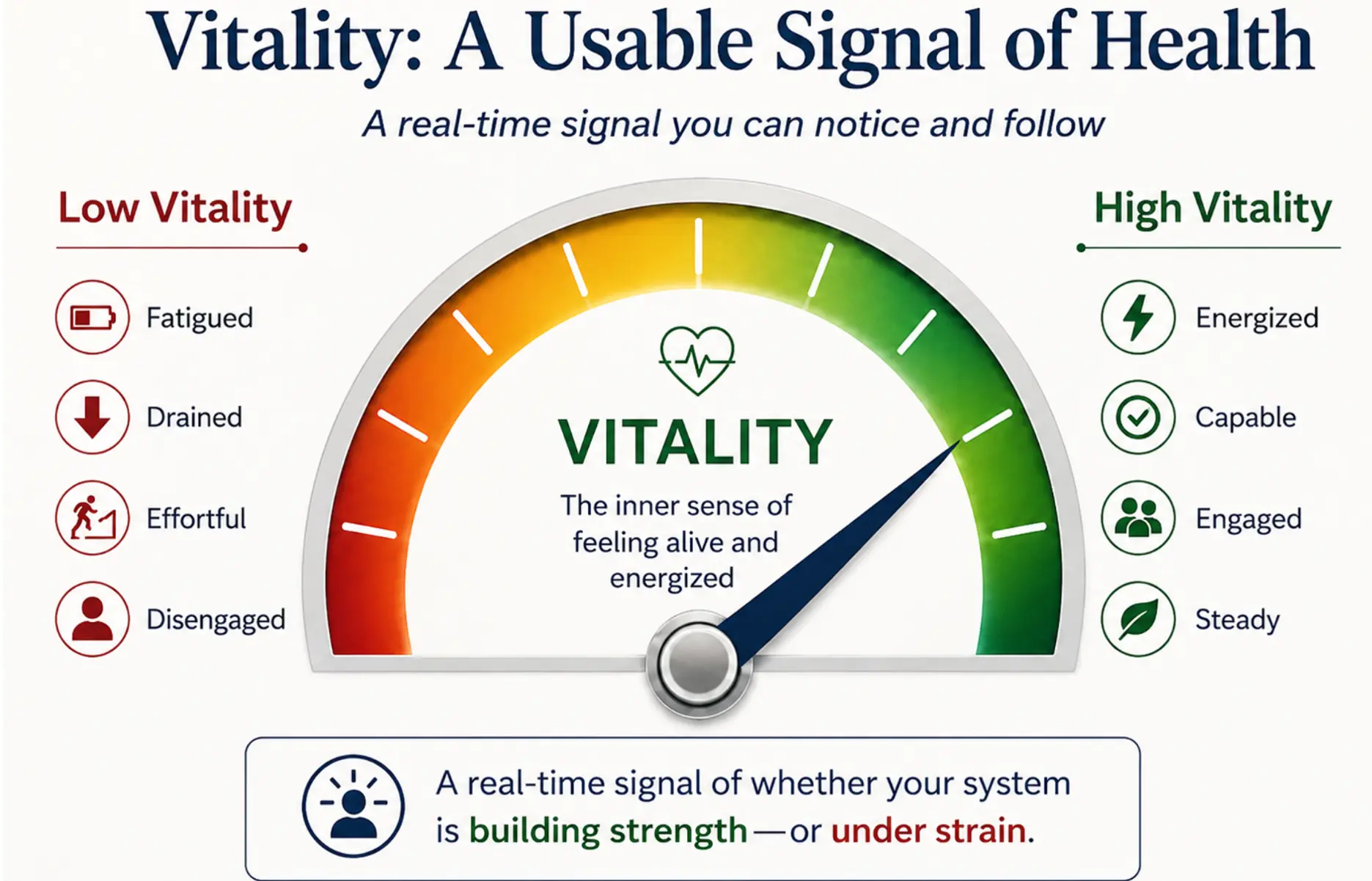
When it’s rising, something in your life is supporting your biology. When it’s chronically low, something is out of balance, often long before illness appears on a test. It functions not as a diagnosis but as an early signal.
The question, then, is not whether vitality matters – but whether we are paying attention to it.
REFERENCE
- Ryan, R. M., & Frederick, C. (1997). On energy, personality, and health: Subjective vitality as a dynamic reflection of well-being. Journal of Personality, 65(3), 529–565.
Vitality isn’t just a feeling. It’s feedback.