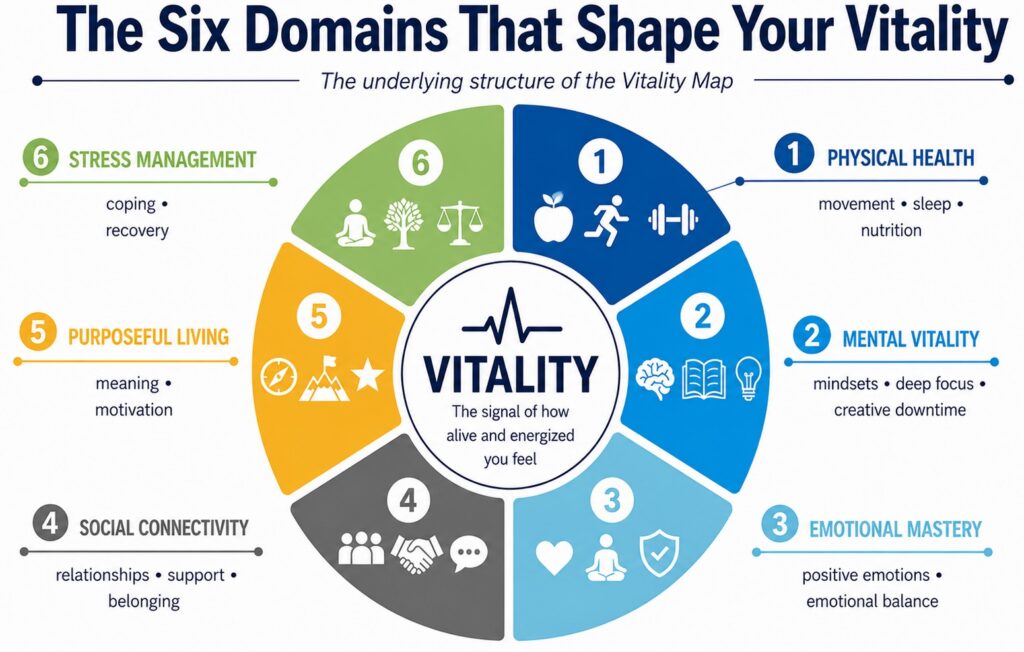
To apply the Vitality Map in real time, it is helpful to have a clearer understanding of where vitality comes from.
In the previous essay, I described how vitality rises and falls in response to how we live. When you begin to pay attention, patterns emerge. Certain activities, habits, and experiences restore your energy, while others diminish it.
These patterns are not random. They tend to fall into specific areas of life. These areas form the underlying structure of the Vitality Map. They are what I refer to as the Six Domains of Health and Vitality. Together, these six domains form the core structure of how health is built.
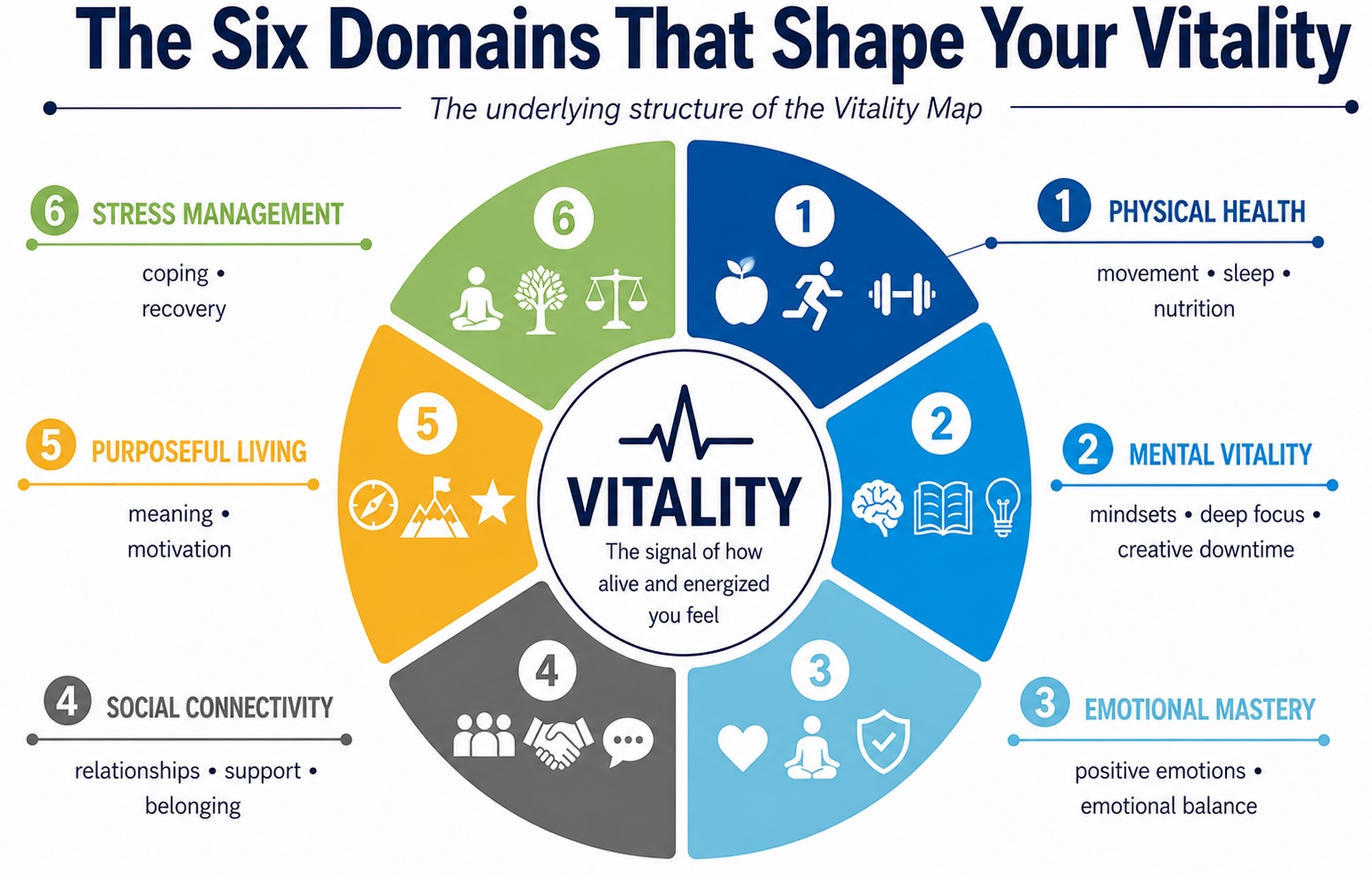
To understand the map fully, we must understand these domains—because they are the sources from which vitality rises or falls.
The Six Health Domains
As discussed earlier in this series, these domains are not an arbitrary construct. They arise from a simple and objective principle:
The body itself testifies to what is healthy and unhealthy. Those factors that protect and promote physiological functioning, reduce disease risk, and support longevity are health-promoting. Those that impair functioning and accelerate deterioration are unhealthy.
These factors fall into six large domains, each representing a fundamental area of life that strongly influences how well we function.
1. Physical Health
Physical health reflects the condition and functioning of the body itself. It rests on four essential pillars: nutrition, movement, strength, and sleep.
Regular movement promotes the functioning of nearly every major physiological system. Strength training supports metabolic and brain health while preserving muscle, bone, and balance. A healthy diet rich in whole foods regulates metabolism while fueling every system in the body. Sleep drives repair, renewal, and healthy brain and physiological functioning.
In contrast, lack of exercise, poor nutrition, and inadequate sleep lead to physiological deterioration, accelerating aging and disease risk.
2. Mental Vitality
Mental vitality is built by nurturing positive mindsets such as optimism and gratitude, and by practices that support brain health, including deep focus, restorative breaks, and creative downtime. Negative mindsets and habits such as constant web surfing sap mental vitality.
3. Emotional Mastery
Emotional mastery reflects skills that foster positive emotions and reduce the frequency and toxicity of negative ones. Positive emotions lower disease risk, whereas chronic negative emotions elevate stress hormones, fuel inflammation, and disrupt key physiological systems.
4. Social Connectivity
Social health, reflected in the size and quality of one’s social network and close relationships, is a powerful driver of biological health. In contrast, loneliness, isolation, and social conflict increase stress and are associated with increased disease risk and mortality.
5. Purposeful Living
Purposeful living is both a basic psychological need and a powerful biological influence. A strong sense of purpose is associated with lower risk of heart disease, stroke, and cognitive decline. Conversely, a low sense of purpose increases the risk of chronic disease and premature mortality.
6. Stress Management
Stress management reflects the ability to regulate and recover from life’s challenges. When stress is well managed, it supports resilience and healthy functioning. By contrast, toxic stress—chronic, poorly managed stress associated with emotional strain—impairs physiological functioning, accelerates aging, and increases disease risk.
Why These Are Also the Domains of Vitality
These six domains do more than determine health. They help determine our vitality.
When physical health is strong, energy is higher and fatigue less frequent. When the mind is clear, thinking feels easier. When emotional life is stable, less energy is consumed by internal strain.
Supportive relationships provide energy rather than drain it. When life feels purposeful, engagement increases. When stress is balanced by recovery, the body maintains its capacity to restore itself.
The opposite is equally true. Poor sleep lowers energy. Chronic emotional strain diminishes vitality. Loss of purpose weakens motivation. Unrelieved stress leads to fatigue.
Vitality is not random – it is the signal that reveals how well the key domains of your life are truly functioning.
The Six Domains Form the Terrain of the Vitality Map
Most people are not accustomed to monitoring their vitality. They notice it mainly when it is low—when fatigue appears, and energy becomes harder to access. At that point, vitality feels like a problem, but its cause is often unclear.
Understanding the six domains changes this. It allows you to begin playing detective. When vitality shifts, you can look beneath the surface and identify which domain may be contributing.
These domains are highly interconnected. When vitality declines in one area, it often spreads to others. Poor sleep weakens emotional balance. Chronic stress impairs mental and physical functioning. Loss of purpose often leads to disengagement, which gradually erodes both mental vitality and social connection.
But the opposite is also true.
As vitality improves in one domain, it often strengthens others. Better sleep improves emotional stability. Physical activity sharpens mental clarity. Renewed purpose increases energy across life.
Vitality is not fixed. It is dynamic and capable of being built and rebuilt.
Vitality is not random—it is the signal that reveals how well the key domains of your life are truly functioning.