From Philosophy to Observation
Once I began paying close attention to how the body actually responds to different influences, health stopped feeling philosophical and started feeling practical.
Instead of debating what health ought to mean, I found myself watching what the body consistently rewarded — and what it quietly penalized. Some behaviors strengthened the system. Others strained it. And the effects weren’t abstract. They were measurable, repeatable, and remarkably consistent.
Over time, a simple realization took shape. Health isn’t a mysterious state you either possess or don’t. It isn’t something discovered at an annual checkup or rescued after symptoms appear. Across different studies, populations, and decades, the same protective forces kept surfacing.
Health clustered around a small number of reliable influences.
In that sense, health isn’t something you find.
It’s something you steadily build.
The Physical Foundations
The first set of influences is the one most of us recognize instinctively: the pillars of physical health.
Movement, strength, nutrition, and sleep form the visible pillars of health. Regular activity keeps the cardiovascular and metabolic systems resilient. Resistance training preserves muscle and bone, protecting independence as we age. Nutrition supplies the raw materials for repair. Sleep is when restoration actually occurs.
When these pillars weaken, the body loses capacity. Stamina slips. Strength fades. Recovery slows. Risk rises. This part feels intuitive. Most people understand, at least in theory, that these habits matter.
But over time it became clear to me that this physical layer is only part of the story.
The Hidden Inputs
Another set of influences kept appearing in the data — factors we rarely label as “medical,” yet that affect physiology just as powerfully.
How we think.
How we regulate emotion.
How connected or isolated we feel.
Whether life feels meaningful.
How we respond to stress.
At first glance, these seem like psychology, not biology. But the body doesn’t recognize that distinction. From a physiological standpoint, they are inputs that influence the same biological pathways as diet and exercise.
Persistent pessimism and depression are associated with higher rates of heart disease. Chronic loneliness carries risks comparable to many traditional medical factors. Ongoing stress alters cortisol, sleep, appetite, and metabolism, promotes inflammation and insulin resistance, and gradually strains the cardiovascular system.
Conversely, optimism, emotional steadiness, strong relationships, a sense of purpose, and effective stress regulation are consistently linked to stronger physiology, greater resilience, and longer life.
From the body’s perspective, it’s all biology.
The Pattern Becomes Clear
Step back far enough, and the pattern becomes surprisingly simple.
Health is not governed by dozens of unrelated habits. It clusters into a small number of domains that repeatedly shape whether our physiology trends toward resilience or decline. Over time, these domains crystallized for me into a kind of map—a practical framework for understanding what builds health and what quietly erodes it. This can be viewed in a simple way:
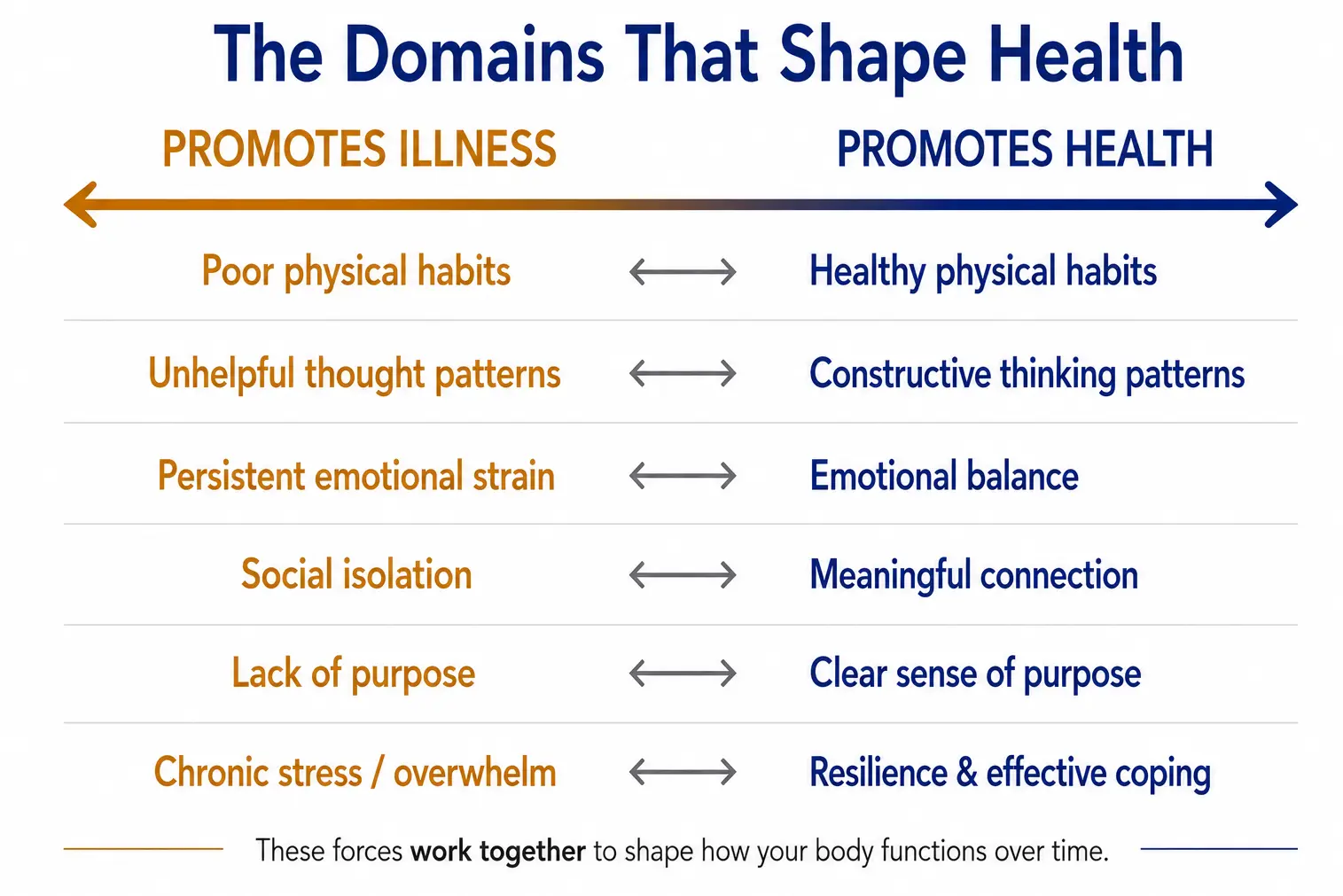
Each domain lies on a spectrum. On one side are forces that strain the system. On the other are forces that strengthen it: sedentary behavior versus movement, isolation versus connection, chronic distress versus effective coping, negative versus positive mindsets, and aimlessness versus purpose
Day after day, these inputs push our physiology in one direction or the other.
Not dramatically.
But steadily.
A Different Way to Think About Health
Once you see health this way, the questions change.
Instead of asking only What’s my cholesterol? or Are my labs normal? you begin asking different questions: Am I getting stronger or weaker? Sleeping well or poorly? Handling stress constructively or carrying it constantly? Am I connected to people who matter? Does my life feel purposeful?
These aren’t soft or abstract concerns. We often label them “lifestyle” or “psychological,” but they act directly on the body’s physiology. Together, they determine whether health is quietly being built — or quietly slipping away.
Where This Leads
This framework helped me organize decades of research into something practical. It showed me that health isn’t a philosophy or an ideal. It’s the cumulative result of everyday forces that steadily shape the body over time.
But this still leaves a deeper question.
If these domains build health…
what exactly are we trying to build?
In the next blog, we’ll turn to that directly — and define health not simply as the absence of disease, but as the presence of something far more concrete and measurable — something you can recognize, cultivate, and strengthen throughout your life.
Health is revealed by what the body consistently rewards – and what it quietly penalizes.