How Healthcare Quietly Trains Us to Equate “Healthy” with “Not Sick”
In the first two blogs in this series, I explored a simple but unsettling observation: although most of us say health is more than the absence of disease, we rarely experience it that way. In everyday life, “healthy” quietly becomes synonymous with “nothing seems wrong.”
At first, this feels like human nature. We take our health for granted and only notice it when something hurts or breaks.
But another force shapes this mindset just as strongly.
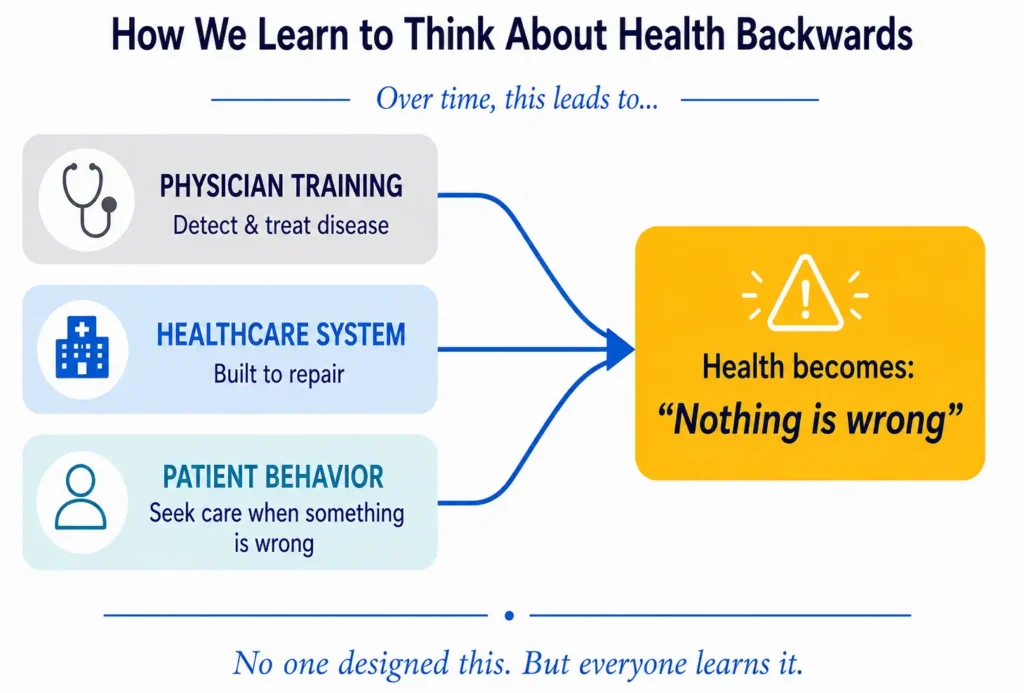
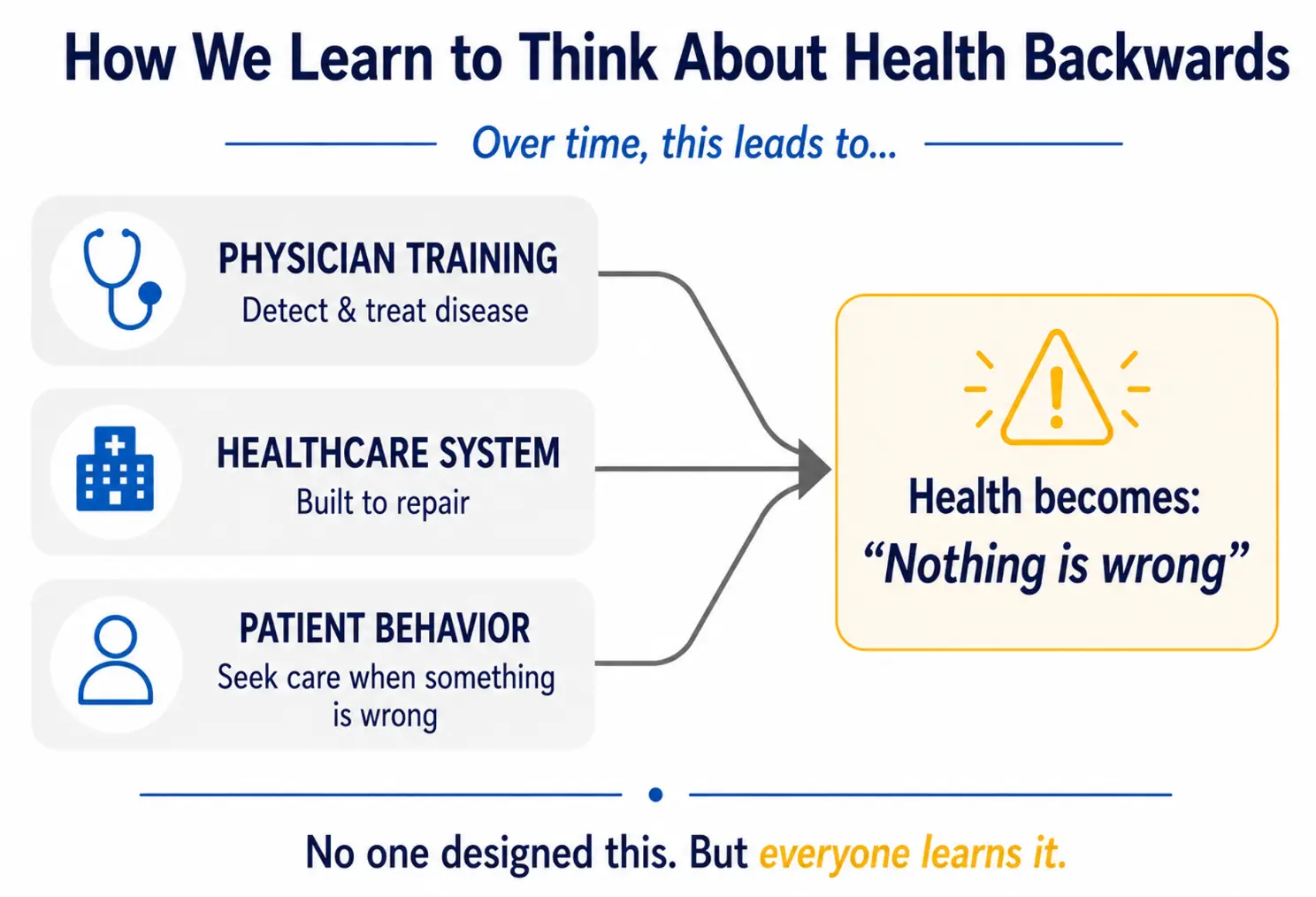
Our experience with healthcare itself subtly trains us to think this way. To see why, it helps to look at the problem from three perspectives: the physician, the system, and the patient.
The Physician’s View
I still remember the excitement of my first years in medical school. Learning physiology felt like discovering the body’s hidden logic. By the time I reached the wards, that knowledge had a clear purpose: identify what’s wrong and fix it.
Hospitals, after all, are filled almost entirely with sick people.
We learned the “review of systems,” a structured way of asking questions to uncover disease. It felt like detective work. That mindset carried forward through internship and residency, where daily life revolved around diagnosis and treatment.
And that makes perfect sense. The first duty of a doctor is to relieve suffering. Patients come because something is wrong.
But notice what’s missing.
In all those years of training, almost no one asked me how to measure strength, resilience, or day-to-day functioning. I became highly skilled at recognizing disease. I wasn’t trained to systematically build health.
A System Built for Repair
The structure of healthcare reflects that same logic.
Hospitals exist to treat acute, often life-threatening problems — infections, trauma, heart attacks, surgical emergencies. When someone can’t breathe or is bleeding, you intervene.
Insurance reimburses procedures and treatments. Clinics revolve around conditions. Screening tests detect early disease. Success is measured by what we find or fix.
All of this saves lives every day.
But a system designed for repair is not automatically designed for cultivation. It is excellent at treating illness once it appears, yet far less equipped to help people steadily build strength, fitness, emotional well-being, or meaningful connection over time.
Healthcare can repair health. It was never designed to create it.
The Patient’s Experience
Now consider the patient’s side.
When do most of us see a doctor?
Rarely when we feel strong and energetic and want to become even stronger. More often, we go because something hurts or worries us.
Tests are run. If everything comes back “normal,” we feel reassured. Then we go home. Without anyone explicitly saying it, we absorb a simple lesson: if nothing shows up on the tests and nothing hurts, we must be healthy.
Over time, “not sick” quietly becomes our definition of “well.”
The Consequence
Put these three perspectives together, and the outcome becomes predictable. Physicians are trained to detect disease. The system is built to repair illness. Patients show up when something feels wrong.
Without anyone intending it, healthcare quietly trains all of us to think about health in reverse.
Everyone is acting rationally, yet together we reinforce the same narrow definition. We become very good at monitoring and reacting, while rarely asking how to deliberately build the capacities that make disease less likely in the first place.
Normal results become the goal. The absence of a diagnosis feels like success. Yet anyone who has felt exhausted, deconditioned, lonely, or emotionally drained despite “normal tests” knows something important is missing. A medical chart can look reassuring while everyday life feels diminished.
The problem isn’t that healthcare is failing. It’s that we’re asking it to do something it was never designed to do. And when the system around us focuses primarily on detecting problems, it quietly teaches us to do the same.
Which leaves an obvious question:
If healthcare is designed to treat illness, who is responsible for building health?
And what does health actually mean?
Our healthcare system wasn’t designed to build health; it was built for repair.