In earlier essays, we defined vitality as the inner, pleasurable sense of feeling alive and energized—the kind of energy that naturally moves you toward action. That definition is easy to misunderstand.
When most people hear the word “energy,” they think of something purely physical—how rested they feel, how much stamina they have, or how productive they can be. But vitality is something deeper. It is not simply the state of having energy. It is the state of feeling alive.
And that distinction matters, because vitality does more than influence how much you can do. It shapes how fully you are able to do it—and who you are while doing it.
The Hidden Driver of Performance
In today’s world, there is no shortage of advice on how to perform better—new productivity systems, new tools, new strategies for managing time and attention. Most of these approaches assume that performance is primarily a matter of technique.
But they overlook something more fundamental. Vitality is the hidden operating system of performance. Your skills, experience, and knowledge determine what you are capable of doing, but vitality determines how fully those capabilities can be expressed.
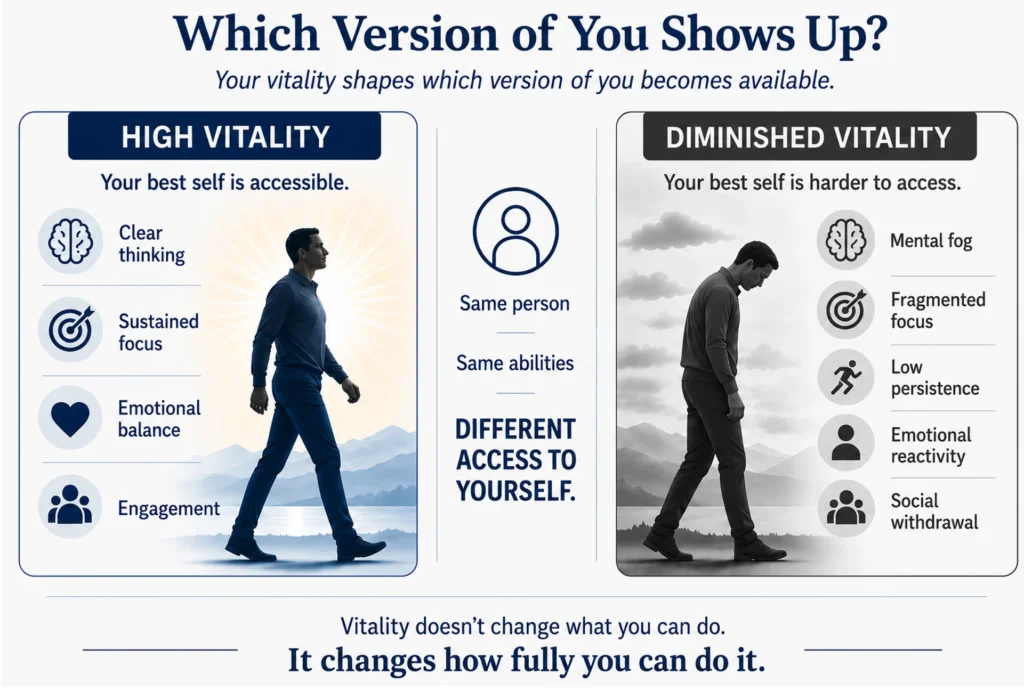
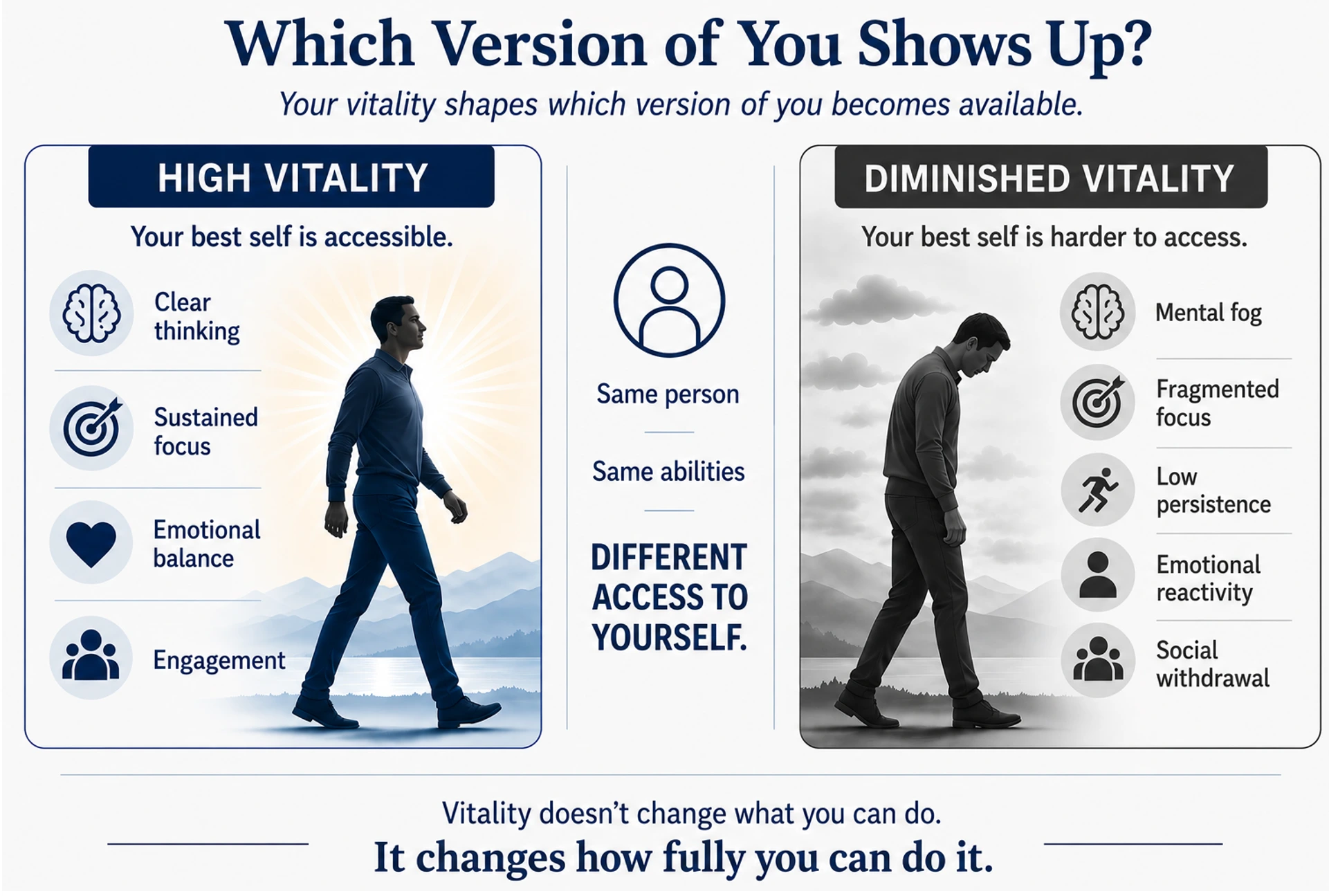
When vitality is strong, thinking is clear, effort is sustained, focus holds, and you adapt more easily under pressure. When vitality is depleted, everything becomes harder. Concentration fragments, persistence weakens, and even simple tasks require more effort.
Your abilities have not disappeared—but your access to them has diminished.
The Vitality Tax
Most people do not experience this as a dramatic collapse. Instead, they pay what might be called a quiet “vitality tax.”
You pay it when you have to read the same paragraph multiple times because your focus has slipped, when a meaningful idea feels like too much effort to pursue, or when a minor frustration feels disproportionately heavy.
In these moments, you have not lost your intelligence, creativity, or experience. You have simply lost the internal energy required to fully access them.
This is why two people with similar abilities can perform very differently—the difference is often not talent – it is vitality.
The Two Versions of You
You can see this most clearly by comparing two different days.
On a day when your vitality is high, your thinking is clearer and your emotional balance more stable. You are less easily thrown off by small frustrations and more willing to engage with challenges. Difficulties may still arise, but they feel manageable, and you trust your ability to respond.
Without trying to be different, you simply function as a more capable version of yourself.
On a day when vitality is low, the opposite occurs. Frustrations feel larger, focus becomes harder to sustain, and your emotional margin shrinks. You may withdraw or feel less confident in situations that normally would not trouble you.
It is not just your productivity that changes—it is your experience of yourself.
Vitality and Your Sense of Agency
Vitality shapes something more fundamental: your sense of agency — the feeling that you can move your life forward.
When vitality is strong, you initiate, engage, and persist. When vitality is low, even meaningful goals can feel distant—not because they no longer matter, but because the internal fuel required to pursue them is missing.
The same dynamic extends to your relationships. When energy is available, it becomes easier to extend attention, patience, and presence. Conversations feel more natural. Engagement feels less effortful. People respond not only to your words, but to the energy behind them.
The Deeper Insight
Until now, we have understood the six domains of health as sources of vitality. But vitality does more than make you feel energized—it amplifies everything else. It shapes your performance, your relationships, your resilience, and your sense of self.
Most people try to improve their lives by changing what they do—working harder, managing time more efficiently, or adopting new strategies—without recognizing that something more fundamental is shaping how effective those efforts can be.
Vitality operates at that deeper level. It determines how fully your abilities can function and how fully you can express yourself.
Rather than asking only, “How can I get more done?” a better question may be: “How much more would be possible if I had the energy to sustain my best self?”
Vitality is not a luxury. It is a force multiplier.
And perhaps its most profound effect is this:
It does not simply change what you can do. It changes who you are able to be.
Vitality does not simply determine what you can do. It determines which version of you shows up.