
How to Maintain Modern Friendships
Decades ago, I met Mike Levin in Los Angeles. We became close friends, sharing weekly breakfasts and dinners. Even after I moved to New York, we kept up through my annual trips back to LA. But then life got busier.
It’s now been two years since my last trip. Mike called me three weeks ago to catch up—and I still haven’t returned his call. I intend to. It nags at me that I haven’t.
Why the hang-up? Not because he doesn’t matter, but because of the constant pull of smaller urgencies. The friendship lingers on my to-do list, just never at the top.
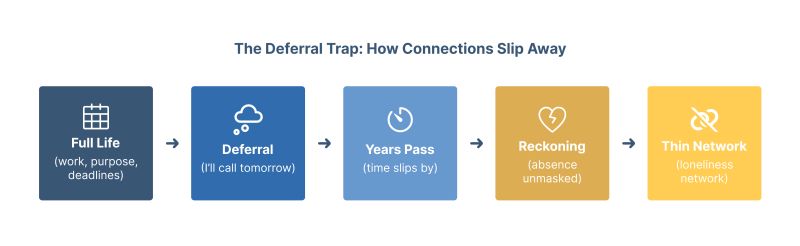
That’s how connection slips away—not by decision, but by delay.
The Deferral Trap
When life feels full—meaningful work, urgent demands, constant activity—it’s easy to tell ourselves we’ll tend to relationships later. We text, we “like” a post, maybe we send a quick emoji, and convince ourselves that counts. Meanwhile, lunches with friends get postponed, calls go unanswered, and community begins to feel optional.
But later can become decades. Purpose can fulfill us, and busyness can distract us—but both can trick us into postponing our deepest social needs. Because our social needs rarely feel urgent, they’re often displaced by deadlines or caregiving. But friendships can’t be shelved and restarted later; they need ongoing investment.
When “Later” Catches Up
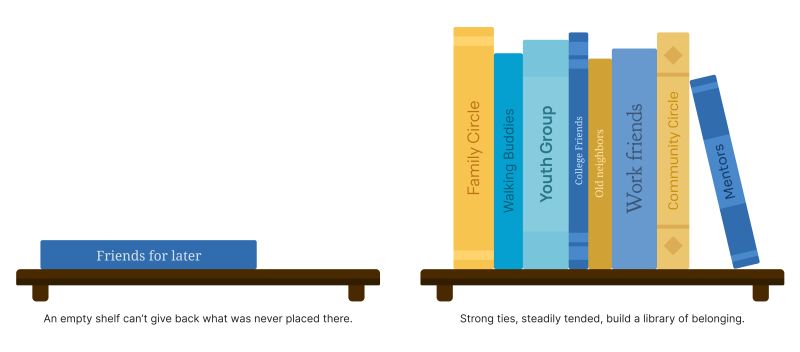
There are moments in life when the absence of social investment is suddenly unmasked. The reckoning often comes in retirement, when professional purpose no longer structures daily life. During such times, you can’t pull connection off the bookshelf if you never put it there.
A similar reckoning can also arise during illness, after the loss of a spouse, in times of financial hardship, when adult children move away, or in the midst of a midlife crisis. In those moments, many discover that the network they assumed was waiting on the shelf has grown thin.
The Seductions of Modern Work Life
Modern work life offers endless chances to build, create, and achieve. We can launch startups, chase ambitious careers, pour ourselves into creative projects, or stay “connected” through constant digital interaction. The momentum feels intoxicating—and it keeps us busy enough to ignore the sense that something may be missing.
But busyness carries hidden costs. A recent Wall Street Journal piece profiled young AI founders working 90-hour weeks and proudly sidelining everything else—vacations, milestones, even friendships. “Why would I go drink at a bar if I can be building a company?” one asked.
This mindset isn’t new, and it’s not limited to Silicon Valley. Across careers and life stages, many of us absorb the idea that relationships are optional, something to return to later when the work is done.
But habits like these, reinforced year after year, quietly erode the foundation of connection. And when “later” finally arrives, reconnecting may require creative effort—but it remains possible, especially if approached with intention.
Set Minimum Standards
The key safeguard against social decay is to establish minimum standards for your social life—a baseline that protects the relationships you most value. This means asking: Who do I want to stay in touch with? Why do they matter? How often should we connect?
You don’t need to script every friendship, but naming your “inner circle” helps clarify where to invest. For some, that might include a weekly call with a sibling. For others, a monthly lunch with a friend or a yearly trip with a small group. The point is consistency.
Minimum standards act like guardrails, keeping important ties from being lost to the tide of smaller urgencies. If too much time has passed, it’s a signal: reach out, even if it means pausing something else.
Practical Ways to Avoid the Deferral Trap
- Invest early. Don’t wait for retirement or a career slowdown. Begin nurturing friendships now, even when life feels too full.
- Treat relationships as priorities. Schedule time with friends as deliberately as meetings and projects. Simple rituals help—like a weekly call or a monthly lunch. Small, steady practices turn intention into habit, and habit into lasting connection.
Balancing Purpose and Belonging
Purpose steadies us and carries us through hardship, but it cannot replace belonging. Friendships need attention along the way, not someday.
When we balance purpose with connection, we build not only achievement but companionship—resilient not just in what we do, but in who stands beside us.
A simple place to start is by setting minimum standards: decide who matters most and commit to showing up. Name your circle, establish a pattern, and put it on the calendar.
But don’t wait for the perfect time—“later” has a way of never arriving.