
The Vital Importance of Social Connection
One of the most powerful determinants of health—including physical health—is also one of the most overlooked. Ignore it at your own risk.
That determinant is the strength of our social ties: the ability to connect to, and feel connected with, other people.
A Basic Psychological Need
Our need for social connection is not optional. It is one of our most profound psychological needs. Just as we have physical needs like food, water, and rest, we also have psychological needs. And while our bodies loudly remind us when physical needs go unmet, our psychological needs send quieter signals.
When connection is lacking, the warning signs may start subtly—feelings of tension, frustration, or emptiness. But if disconnection becomes chronic, the impact goes deeper: our stress systems remain on high alert, our sleep and immunity falter, and our risk of chronic disease rises.
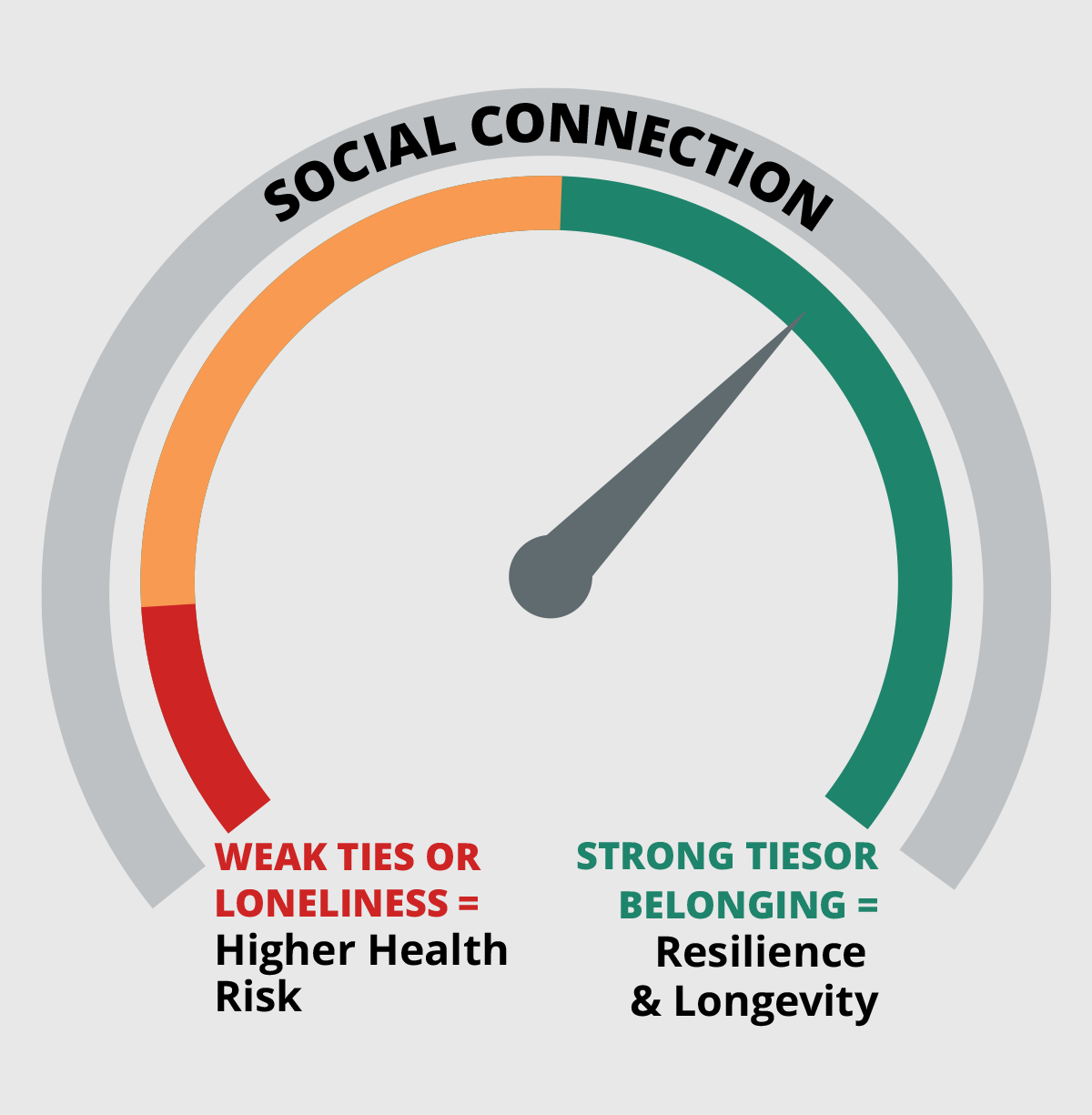
This is why people with very weak social ties, or who live with long-term loneliness, consistently face worse health outcomes—not just emotionally, but physically.
An Ancient Insight, a Modern Echo
The importance of social connection is both timeless and newly affirmed.
Thousands of years ago, sacred texts recognized it: in the Bible, after creating the first human, Adam, the Almighty declares, “It is not good for man to be alone,” and creates Eve.
Across traditions, the message repeats. King Solomon observed, “As water reflects a face, so does a person’s heart”—a reminder that warmth begets warmth, and human hearts mirror one another.
Modern psychology echoes this truth. From Erik Erikson’s view that intimacy is a central task of adulthood, to Abraham Maslow’s hierarchy of needs, to Viktor Frankl’s insights on love and meaning, and to Carol Ryff’s research on psychological well-being, all converge on a single point: our need for connection is fundamental. Belonging and close relationships are not optional extras; they are core human requirements. Without them, we falter. With them, we thrive.
When Medicine Took Notice
For centuries, wisdom traditions affirmed the power of connection, but modern medicine lacked the tools to measure it. That changed in 1979, when a landmark study in Alameda County, California helped bring social connection into the spotlight (1).
Epidemiologist Lisa Berkman and her colleagues followed nearly 7,000 adults for nine years, asking simple questions: Were they married? Did they see friends or relatives regularly? Did they belong to a church or community group?
The results were striking. People with the fewest social ties were two to three times more likely to die during the follow-up period than those with the most ties—even after accounting for age, smoking, alcohol use, exercise, and baseline health.
Just as important, the effect was stepwise: each additional tie—a spouse, a group, a circle of friends—further lowered the risk of death. Relationships weren’t just comforting; they were life-extending.
Beyond Numbers: The Quality of Connection
Soon after, other studies confirmed the Alameda findings and expanded the picture. Researchers began asking not only how many ties people had, but also about the quality of those ties. The results were clear: conflicted or strained relationships predicted worse health, while warm, supportive bonds promoted resilience, faster recovery, and greater well-being.
From One Study to Hundreds
Since that first report, hundreds of studies across the world have replicated and extended these findings. Large-scale reviews and meta-analyses have confirmed that social connection is not a minor factor but a major determinant of health.
One of the most influential studies—a 2010 analysis of more than 300,000 people—found that those with stronger social relationships were about 50% more likely to be alive at the end of the follow-up period (roughly 7 years, on average) compared to those with weaker ties (2).
The protective effect of social ties rivaled—and in some cases exceeded—the benefits of avoiding well-known risks like obesity, physical inactivity, or even smoking.
A Modern Paradox
Even though the benefits and importance of social connection are plain, we live in a generation of paradox. On one hand, we now have greater insight into what might be called social intelligence—the science of how relationships work, how trust is built, how empathy deepens ties, and how communication patterns strengthen or weaken bonds. These insights give us practical tools to improve health and happiness.
On the other hand, maintaining strong, high-quality ties has in many ways become more difficult than in generations past:
- We are busier, more distracted, and more pressed for time.
- Families are more geographically scattered.
- Social media offers the illusion of connection, yet often leaves people feeling more isolated.
- And unlike physical needs, our psychological needs for belonging don’t shout for attention until damage is already underway.
The Takeaway
Social connection is far more than a pleasant bonus in life—it is an important vital sign of health, as essential as blood pressure or cholesterol.
From ancient wisdom to modern research, the evidence is clear: when we nurture relationships, we gain resilience, protection against disease, and a deeper sense of meaning. When ties fray or isolation takes hold, the costs ripple through both body and mind.
In our busy, distracted world, it is easy to overlook this need—but doing so comes at a high price. The challenge of our time is not to prove that connection matters, but to prioritize it amid competing demands.
Choosing to invest in family, friendships, and community is not just about happiness; it is about health, vitality, and living fully at every age.
REFERENCES
- Berkman, L. F., & Syme, S. L. Social networks, host resistance, and mortality: a nine-year follow-up study of Alameda County residents. American Journal of Epidemiology. 1979; 109:186–204.
- Holt-Lunstad, J., Smith, T. B., & Layton, J. B. (2010). Social relationships and mortality risk: a meta-analytic review. PLoS Medicine. 2010; 7, e1000316. https://doi.org/10.1371/journal.pmed.1000316.