Why emotional skills aren’t just helpful—they’re essential to how we live, relate, and thrive.
Growing up, I was a serious student. I studied math, history, and English composition and other academic subjects with dedication. But one subject was never on the syllabus: emotional skills.
Like many people, I had to learn them in fragments—mostly through trial and error. I wish these skills had been taught earlier. And I suspect I’m not alone.
In the 1990s, psychologist Daniel Goleman brought attention to this gap through his work on emotional intelligence—the ability to recognize, understand, manage, and use emotions effectively (1). It includes such skills as self-awareness, emotional regulation, empathy, and the capacity to build strong relationships.
But it’s one thing to understand emotions—emotional mastery is another.
Why Emotional Mastery Matters
Emotional mastery goes beyond insight. It is the ongoing intentional practice of positively shaping your emotional life. It means cultivating uplifting states, working constructively with difficult feelings, and staying grounded in moments of stress.
Its benefits go beyond feeling good. When we’re emotionally engaged in positive ways, we think more clearly, solve problems more creatively, and relate to others more effectively. We become more resilient and resourceful.
Emotional skillfulness also affects those around us. Emotions are contagious. Whether at home, work, or in day-to-day interactions, our emotional states can often ripple outwards upon others, or vice versa.
People naturally gravitate towards those who are grounded, emotionally available, and open-hearted. No one thrives in the presence of chronic irritability, cynicism, or emotional volatility.
In this way, emotional mastery is both a personal asset and a social responsibility.
The Emotional-Health Connection
Emotional mastery also supports physical health. Decades of research have shown that chronic negative emotional states can harm the body. In the 1980s, groundbreaking studies revealed that depression was linked to persistent elevations in stress hormones like cortisol and norepinephrine—both of which, in excess, can impair the body’s ability to function optimally.
Over time, depression has been shown to adversely affect nearly all major physiological systems of the body, ranging from autonomic dysfunction and inflammation, to adverse impact on brain plasticity, including enlargement of the amygdala (the brain’s fear center) and decrease of the prefrontal cortex (2-3).
Conversely, having a high ratio of positive emotions is associated with a reduced risk for heart disease and increased lifespan (4). Even positive dispositions like optimism and gratitude, when sustained over time, appear to support healthier biological functioning (5-6).
Taken together, these medical findings indicate something profound: we don’t just enjoy positive emotions—we seem to require them to thrive health wise.
The Four Capacities of Emotional Mastery
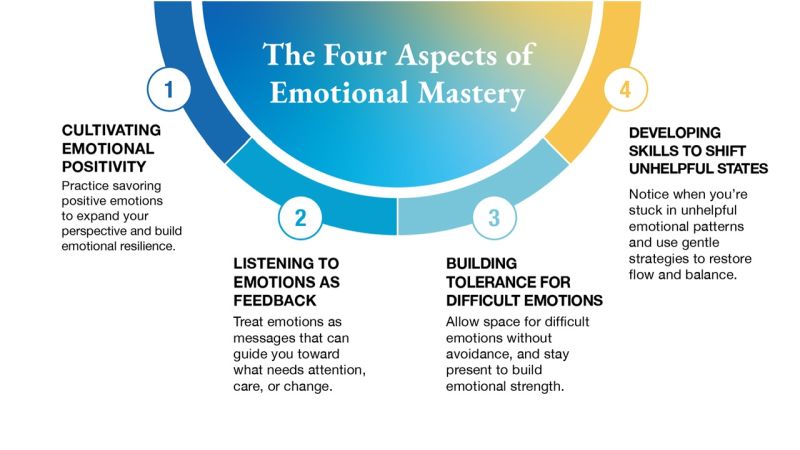
This brings us back to emotional mastery—the key to a thriving emotional life. Emotional mastery consists of four core capacities, each of which supports emotional resilience and long-term well-being:
1. Cultivating Emotional Positivity
At the heart of emotional mastery lies the ability to cultivate positive emotional states, such as joy, gratitude, serenity, and affection. Positive emotions are not luxuries—they are essential nutrients for human thriving. Just as sunlight fuels growth in a garden, positivity fuels resilience, clarity, and vitality in our lives.
Research by psychologist Barbara Fredrickson demonstrates that positive emotions do more than feel good in the moment: they broaden our perspective, unlock creativity, improve problem-solving, and deepen connection with others (7). Over time, this “broaden-and-build” effect accumulates into lasting inner resources—emotional balance, social strength, and even better physical health.
The goal isn’t to eliminate negative feelings—grief, anger, and anxiety have their place—but to ensure they don’t dominate. When the ratio of positive to negative emotions is high, we flourish. When it is low, we falter. That makes emotional positivity not optional, but central to a thriving life
2. Listening to Emotions as Inner Signals
Emotions are not random—they’re information. They reveal what matters to us, what’s out of alignment, or what needs care.
Think of them as the mind’s version of physical pain:
- Anger may signal that a boundary has been crossed or a core value has been violated.
- Sadness may reflect a loss, disconnection, or something unresolved that needs grieving.
- Anxiety may point to uncertainty or a need for safety and stability.
- Guilt might suggest a misalignment between one’s actions and their values.
When we pause to ask what is this emotion trying to tell me?, we tap into an inner guidance system that can foster clarity, healing, and growth.
Building Tolerance for Difficult Emotions
Difficult emotions—such as grief, fear, disappointment, frustration—are part of life. Emotional mastery means allowing space for them without being overwhelmed or reactive.
Avoiding discomfort through distraction, denial, or numbing may offer temporary relief but leads to emotional disconnection over time. Vitality is lost when we stop feeling!
Tolerance begins by allowing what is—and staying present through it.
Developing Skills to Shift Unhelpful States
While all emotions are valid, some states can become unhelpful when they linger without resolution—like prolonged grief that turns paralyzing, chronic irritability that strains relationships, emotional numbness that leads to disconnection, or persistent shame that erodes self-worth.
Emotional mastery involves recognizing when we’re stuck and knowing how to gently shift gears—such as through reframing, physical movement, connection, or calming practices. The goal isn’t to suppress emotions, but to restore flow and flexibility.
The goal isn’t forced positivity—it’s intentional responsiveness. We don’t control our emotions, but we can influence how we relate to them.
Final Thoughts: Practice, Not Perfection
Emotional mastery isn’t about being unshakable or cheerful all the time. It’s about learning to work with your emotional life in ways that support well-being, deepen connection, and foster clarity in the face of life’s challenges.
In future blogs, we’ll explore practical tools and everyday strategies to help you grow these emotional capacities—because with practice, emotional mastery becomes not just possible, but powerful.
REFERENCES
- Goleman, D. (1995). Emotional intelligence: Why it can matter more than IQ. Bantam Books.
- Rozanski A, Blumenthal JA, Kaplan J. Impact of psychological factors on the pathogenesis of cardiovascular disease and implications for therapy. Circulation. 1999; 99:2192-217.
- Rozanski A, Blumenthal JA, Davidson KW, Saab PG, Kubzansky L. The epidemiology, pathophysiology, and management of psychosocial risk factors in cardiac practice: the emerging field of behavioral cardiology. J Am Coll Cardiol. 2005; 45:637-51.
- Chida Y, Steptoe A. Positive psychological well-being and mortality: a quantitative review of prospective observational studies. Psychosom Med. 2008; 70:741-56.
- Rozanski A, Bavishi C, Kubzansky LD, Cohen R. Association of Optimism With Cardiovascular Events and All-Cause Mortality: A Systematic Review and Meta-analysis. JAMA Netw Open. 2019 Sep 4;2(9):e1912200. doi:
- Chen Y, Okereke OI, Kim ES, Tiemeier H, Kubzansky LD, VanderWeele TJ. Gratitude and Mortality Among Older US Female Nurses. JAMA Psychiatry. 2024;81:1030-1038.
- Fredrickson BL. The role of positive emotions in positive psychology. The broaden-and-build theory of positive emotions. Am Psychol. 2001; 56:218-26.