
In today’s noisy, fast-paced world, focus is one of our most valuable mental assets. It powers our best moments—those times when we’re fully immersed in a conversation, engaged in meaningful work, or lost in creative flow. It’s the foundation of productivity, learning, and deep human connection.
Focus also supports our emotional well-being. Being mentally present enriches our experiences and relationships. It sharpens performance, builds confidence, and protects us from spirals of worry or distraction. And at its best, focus brings joy—especially when we’re absorbed in something that challenges or inspires us.
The Decline of Attention Span
We don’t need data to prove it—shrinking attention spans are evident everywhere.
Years ago, my colleague Dr. Daniel Berman launched a three-day cardiac imaging course, now held 37 times. I’ve spoken at most of them. In the early years, my lectures were 45 minutes long. Then 30. Today, most are down to 15–20 minutes, with talk of cutting them to 10.
This trend extends far beyond medicine. Five-minute videos, once considered brief, now seem long. Platforms like YouTube and Instagram favor 15–60 second clips, while even newspapers summarize articles in bullet points.
Everywhere we look, content is shrinking—and with it, so is our tolerance for sustained attention. But this isn’t just a shift in preference. It’s a shift in capacity. We are training our brains to expect—and accept—only fragments of focus at a time.
Other Facets of Focus Are Declining Too
A shorter attention span is just one sign of a deeper erosion. Other key components of focus have also weakened—including the ability to concentrate deeply, resist distractions, and re-engage after interruption. Each has been shaped by the demands and habits of modern life:
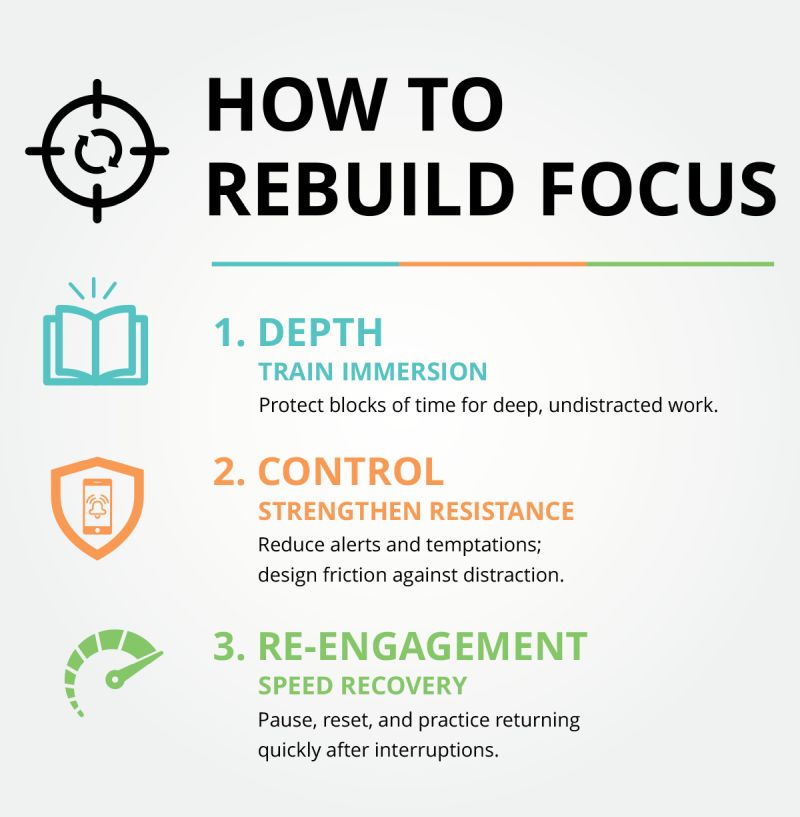
Depth: How Immersed You Can Get
We’ve become a culture of constant interruption—“societus interruptus.” Notifications, emails, texts, and background pings, combined with the pressure to multitask, prevent the brain from entering deeper states of concentration.
At the same time, the endless scroll of bite-sized content trains us to crave novelty and instant stimulation. In this environment, sustained attention starts to feel slow, even burdensome, by comparison.
Add to that the fragmentation of modern digital work—with shifting inputs, open tabs, and unclear boundaries—and it becomes harder to settle into any task with full presence. Instead, we skim, hop between windows, and sample just enough to keep moving—engaging just enough to move forward, but not enough to feel fully present.
Control: How Well You Resist Distractions
Distraction has become frictionless. With a tap or swipe, we shift from task to temptation without even realizing it. Our devices make this seamless—and habitual.
Studies show that even the mere presence of a smartphone, quietly resting nearby, can reduce concentration. Why? Because part of your mind remains on alert, subconsciously waiting for something to happen.
Re-engagement: How Well You Re-Focus After Interruption
Focus isn’t just about staying locked in—it’s also about recovering it when we’re pulled away. And that, too, has become more difficult.
Modern work requires rapid context switching with little time to reset. Research shows that each switch leaves behind “cognitive residue”—mental fragments from the previous task that make it harder to fully engage with the next. Add in emotional spillover and information overload, and the mind begins to lag—like a browser with too many tabs open.
Flexibility means clearing space to return to what matters. Without it, our focus becomes fragmented and increasingly fragile.
The Good News: Focus Is a Skill We Can Reclaim
Focus, like many aspects of modern life, has become a casualty of convenience. Just as our food environment has made nourishment more abundant yet more complicated, our digital environment has made access to information easier—while making sustained focus harder to maintain.
But this isn’t the end of the story. While modern life may chip away at our ability to focus, it hasn’t erased our capacity to rebuild it. Focus is not a fixed trait—it’s a skill. And like any skill, it strengthens through intention, consistency, and care.
In upcoming posts, we’ll explore practical ways to retrain our attention, resist distraction, and restore the deeper focus we’re wired for. The mind is more adaptable than we think—and the rewards of reclaiming our focus run deeper than we often realize.