
Energy and Tension: A Powerful Interaction
In my last blog, I introduced Robert Thayer’s research on everyday moods, showing how our feelings are shaped not just by thoughts, but by the balance of energy and tension in our bodies.
His work highlighted an important truth: energy is more than just “fuel.” It’s the foundation for sustaining focus, emotional balance, and resilience. Thayer found that the quality of our moods—and the actions they spark—hinge on this interaction. When energy is high, tension can be carried productively, keeping us motivated and even upbeat.
But when energy runs low, tension turns corrosive, pulling us into irritability, pessimism, and the draining state he called tense–tiredness.
Why Quick Resets Matter
Energy management isn’t only a long-term challenge; it’s also about what we do in the moment, when fatigue and tension build and we instinctively reach for relief.
In this blog, we’ll look at quick resets: the ones that genuinely restore energy and those that only offer the illusion of it.
Scenario: The Mid-Task Slump
Picture this: you’re finishing a term paper—or in the working world, drafting a report or answering emails. After a couple of hours, tension mounts and your focus slips. You need a break.
What do you do? Most likely, whatever you’ve always done. As Thayer showed, we regulate energy and tension semi-consciously. Beneath the surface, our bodies nudge us toward relief—frequently through food, movement, or distraction.
That’s why so many of us reach for quick fixes. They deliver short-term comfort, and that payoff is what makes them habitual.
The Fork in the Road: Food vs. Movement
One of the most common quick fixes is snacking—often on convenient comfort foods like sweets, chips, or soft drinks. They’re easy to reach for, require little effort, and provide a quick boost. It’s no surprise that raiding the fridge, grabbing a candy bar, or pouring another soda becomes the default fix for so many of us.
But there’s another path: what could be termed “activity snacks.” Short bouts of movement—a brisk walk, stretching, climbing stairs—reset both body and mind (1). They don’t give the instant hit of sugar or caffeine, but their effects last much longer.
And beyond the immediate reset, growing research shows that these brief bursts of activity add up to powerful long-term health gains, from increased longevity to lower risks of cardiovascular disease and cancer (see my past blog on activity snacks).
A Classic Experiment: Candy Bar vs. Brisk Walk
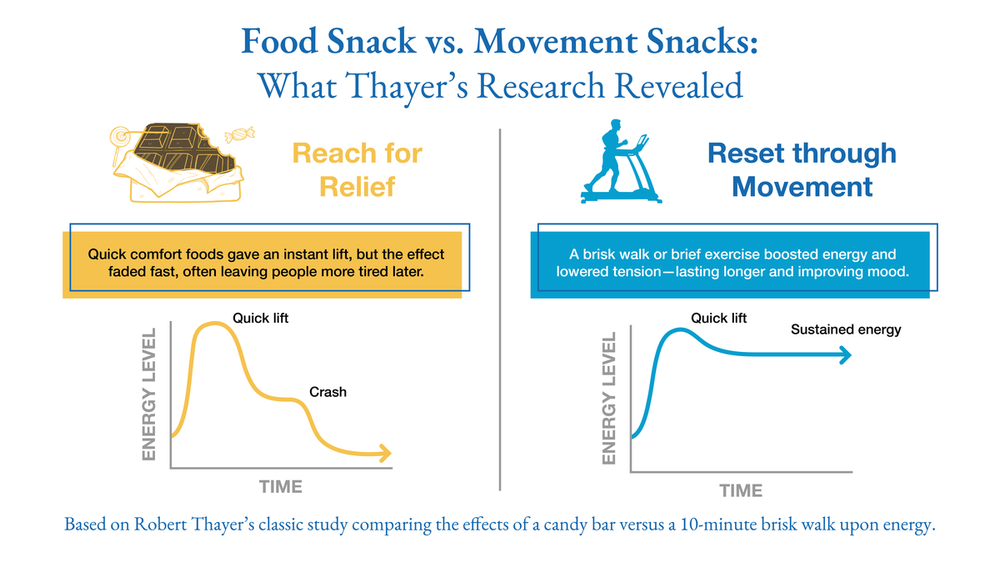
Thayer compared the two paths directly. In one of his classic studies, he asked people low in energy to eat a candy bar or take a 10-minute brisk walk (2).
- Candy bar: Gave a quick burst of energy and mood, but within an hour participants crashed—reporting more fatigue and tension than before.
- Brisk walk: Boosted energy just as quickly, and the benefits lasted for two hours. Tension also declined—and unlike the candy bar, it stayed down without a rebound.
The lesson: tempting fixes like sugar or caffeine may mask fatigue, but the more reliable reset is often the simplest—movement.
Why Movement Snacks Work
As shown by Thayer, Movement helps because it does two things at once: it raises energy and lowers tension. Even a few minutes of activity boost circulation and alertness while easing the tightness that fuels stress.
The payoff? Effects that last long enough to carry you through a slump and get you to the finish line.
These benefits are well established. Research shows that exercise reliably lifts mood and is even used as an adjunct treatment for depression (3). Movement shifts both physiology and psychology—creating a boost that food, caffeine, or screens simply can’t match.
The Rub
The challenge is that when you’re tense and tired, your body doesn’t tell you to move—it tells you to grab something easy, like food, coffee, or a distraction. Over time, the brain has learned to associate these habits with comfort. The result is a loop: low energy triggers the behavior, momentary relief follows, and the pattern repeats—even if it leaves you worse off later.
That’s why movement snacks must become a learned response. They rarely come first to mind in a slump, but with practice, they can replace the automatic reach for the refrigerator or the coffee pot.
Over time, this shift rewires your defaults toward healthier regulation of energy and tension.
The Power of the First Step
If sugary foods or drinks or other negative habits is your usual quick fix, don’t try to fight these habits head-on. Instead, use the power of the first step.
Once a day, when you feel a slump, try a five- to ten-minute movement snack instead of a food snack. That small shift can be eye-opening—often enough to break the loop and show you what true energy restoration feels like.
Small choices, repeated daily, can reset your patterns in lasting ways.