
Reframing Is a Powerful Tool to Combat Negative Thoughts
We’ve all heard the advice: “Just think positive.” But when you’re upset, anxious, or grieving, that advice can feel not only useless—but insulting. If you tell someone in distress to simply replace their negative thoughts with positive ones, you’re likely to get anger in return. That’s because you can’t just flip a switch in your mind and force yourself to believe something you don’t.
Yet there is a way to change your thinking at will—one that is both practical and credible. It’s called reframing, and it’s one of the most powerful tools we have for overcoming negative thoughts, building emotional mastery, and handling life’s challenges.
“Reframing is not about changing the facts—it’s about changing the story you tell yourself about them. And in that shift, everything can look different.”
A Story: Learning to Reframe
When Steve Felt Stuck
Years ago, one of my cardiology trainees came to me with a personal problem. For the purpose of anonymity, we’ll call him Steve. He was 34 years old, newly married, and extremely close to his family.
When his father accepted a job overseas that would take him away for several years, Steve felt devastated. His sister, still living at home, was also very dependent on their parents. The thought of this separation left him anxious, resentful, and stuck in negative thoughts he couldn’t shake.
Why Reframing Feels Impossible at First
When Steve first came to me, he admitted he didn’t know how to reframe his thoughts at all—and doubted he could. That’s common. We’ve all studied math or science, but few of us were ever taught the practical skill of cognitive reframing. So when distress comes, many assume perspective can’t change.
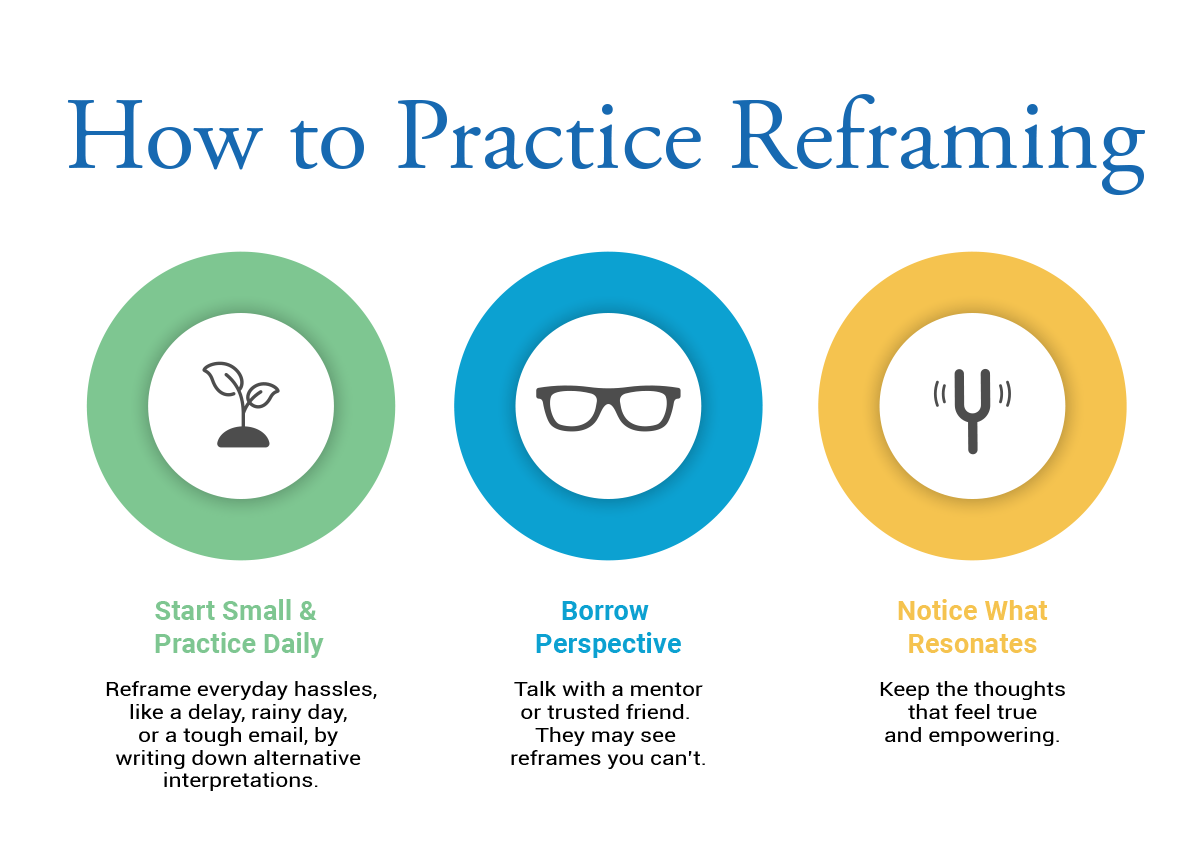
Starting Small
I first asked Steve to begin with one upsetting thought each day and list as many alternative interpretations as possible—whether he believed them or not.
This was like stretching before exercise: warming up the mental muscles needed for reframing.
After Steve became comfortable with this exercise over a couple of weeks, I next asked him to rate each reframe for credibility. Did it feel flimsy, or did it carry weight? This matters because only the thoughts that feel true begin to loosen the grip of negative thinking.
Soon, Steve also grew comfortable with this practice.
Applying It to Real Life
Then I asked Steve to bring his father’s move into the exercise. At first, he could only see it as a painful loss. But after working at it, Steve came up with three possible views:
- From his father’s perspective: “The kids are grown, this is his dream job, and it won’t last forever. He deserves to take this opportunity.”
- From his mother’s reassurance: “Mom promised to visit every two months, and the years will pass quickly.”
- From his own stage of life: “I’m newly married and about to start a family. This is a chance to grow closer to my wife, and my sister needs to become more independent.”
When I asked which felt most credible, Steve paused. The first two sounded reasonable—but didn’t move him. The third, however, struck a chord. Steve realized what troubled him most wasn’t just his father leaving, but his own resistance to letting go of his old role in the family.
By focusing on his new marriage and his sister’s growth, he found a perspective that rang true—and gave him relief.
Later, Steve told me this exercise was transformative. It turned a painful situation into an opportunity for growth.
What he was learning, step by step, are the essentials of reframing your thoughts—skills anyone can practice.
The Three Steps of Reframing
Steve’s experience highlights a process we can all use. Reframing may sound abstract, but it comes down to three practical steps:
1. Recognize that thoughts are interpretations, not facts.
The stories we tell ourselves aren’t reality itself—they’re versions of reality. Recognizing this is like loosening the soil. Once the ground is softer, new perspectives can take root.
2. Generate alternatives.
Once you’ve acknowledged that your current thought is just one possible view, ask: “What are some other ways of looking at this?” The goal isn’t to deny your feelings, but to widen your lens. This is the essence of cognitive reframing—expanding your perspective.
3. Test for credibility.
A reframe only works if it rings true. Think of it like shooting a basketball—you often know the moment it leaves your hands whether it’s going in. Similarly, the right reframe feels grounded and believable.
Why Reframing Works
Reframing doesn’t erase pain or make hard circumstances easy. What it does is shift your relationship to your thoughts. Instead of being trapped inside one narrow, negative frame, you step back and recognize the larger picture.
This creates emotional flexibility—the ability to adapt, recover, and even grow in the face of adversity. And over time, the more you practice reframing, the more resilient you become.
Final Thought
Reframing is not “positive thinking.” It’s not about forcing a smile or denying reality. It’s about choosing the frame through which you view your life—and finding the one that gives you the greatest strength.
Start small, practice often, and share your attempts with people you trust. With time, reframing becomes less of an exercise and more of a habit. And when it does, you’ll find that even in difficult circumstances, you can discover a perspective that brings clarity, hope, and peace of mind.