
The Elusiveness of Peace Today
Peace of mind has always been a universal aspiration—whether through meditation, philosophy, prayer, or the relief of a hard day’s work.
Yet in today’s world, peace of mind feels harder than ever to come by. Despite enormous progress in medicine, technology, and convenience, stress, anxiety, and depression continue to rise. Why?
Part of the problem is how we think about peace of mind itself. Most of us define it in one dimension only: as the absence of negative thoughts and emotions. That understanding is true—but incomplete. In the digital age, there is another force, quieter but also destructive, that strips us of peace: scatteredness of mind.
The Traditional View: Peace as Freedom from Negativity
When people describe a lack of peace of mind, they usually mean being caught in an inner storm. Worries about the future, regrets from the past, or the sting of anger, resentment, or fear can keep the mind restless all day.
It feels like a crowded room of unwelcome guests, none of whom will leave.
This way of understanding peace of mind—as relief from troubling inner content—has guided human thinking for millennia. A mind full of worry or regret is rarely at peace. But as accurate as this view is, it is not the whole picture.
The Overlooked Dimension: Scatteredness of Mind
Even in the absence of negative thoughts, peace of mind can slip away. Picture the effort of trying to concentrate while your attention is yanked in five directions at once—emails, notifications, half-finished tasks, background news, another buzzing reminder. None of these thoughts are hostile or fearful, yet the fragmentation produces its own kind of unrest.
Peace arises when the mind is steady and unified, like a calm lake. Scatteredness is its opposite because it breaks attention into ripples that never let the surface rest.
Why Scatteredness Erodes Peace
Why does scatteredness feel so corrosive? Neuroscience points to several mechanisms that explain why a fragmented mind never settles.
- Cognitive switching costs – Every time you shift focus—say, from drafting a report to glancing at a text—your brain must reorient. That reorientation consumes energy and leaves behind a subtle trace of unease. Multiply this by dozens or even hundreds of switches a day, and the result is fatigue and irritability.
- Attention residue – When you check your email mid-task, part of your mind lingers on what you just read. Did I reply properly? Should I respond now or later? This “residue” competes with your current focus, leaving you half-engaged in both.
- Loss of depth – Constant interruption blocks immersion. When you hop between browser tabs or scroll your phone while half-listening to a conversation, your mind never sinks into the deep, rewarding state of focus that brings clarity and satisfaction. Life stays on the surface—busy, but shallow—and the peace that comes from depth never arrives.
Together, these mechanisms explain why scatteredness doesn’t just waste time. It erodes the very conditions that allow the mind to feel calm, steady, and at ease.
Why Scatteredness Has Become Central in the Digital Age
Distraction is not new, but today’s attention economy has turned it into a chronic condition. Every notification and feed is designed to lure the mind away from what it is doing.
The result is a culture of partial attention. We skim rather than sink in, consume fragments rather than wholes. Even without a single negative thought, this restless mode leaves us uneasy.
The cost of scatteredness is not just lost productivity. It is also lost peace of mind.
Everyday Examples: How It Feels in Practice
You’ve just poured a fresh cup of coffee to write a report, but a single text pulls you in. One click leads to email, then a quick scroll on social media, and twenty minutes vanish. You return to your report, the coffee is cold, and your mind feels like a blurry tab you can’t quite focus on.
You’re talking with a friend when your phone buzzes. You glance at the screen for a second, but even as you nod along, part of your mind keeps replaying the notification you saw.
At night, you want to rest, but unfinished tasks and stray thoughts keep your mind skipping from one thing to another, never settling into quiet.
None of these moments necessarily involve fear or worry. Yet they all feel restless and unsatisfying because peace isn’t just about what you think—it’s about the quality of your attention.
The Bigger Picture: Two Enemies of Peace
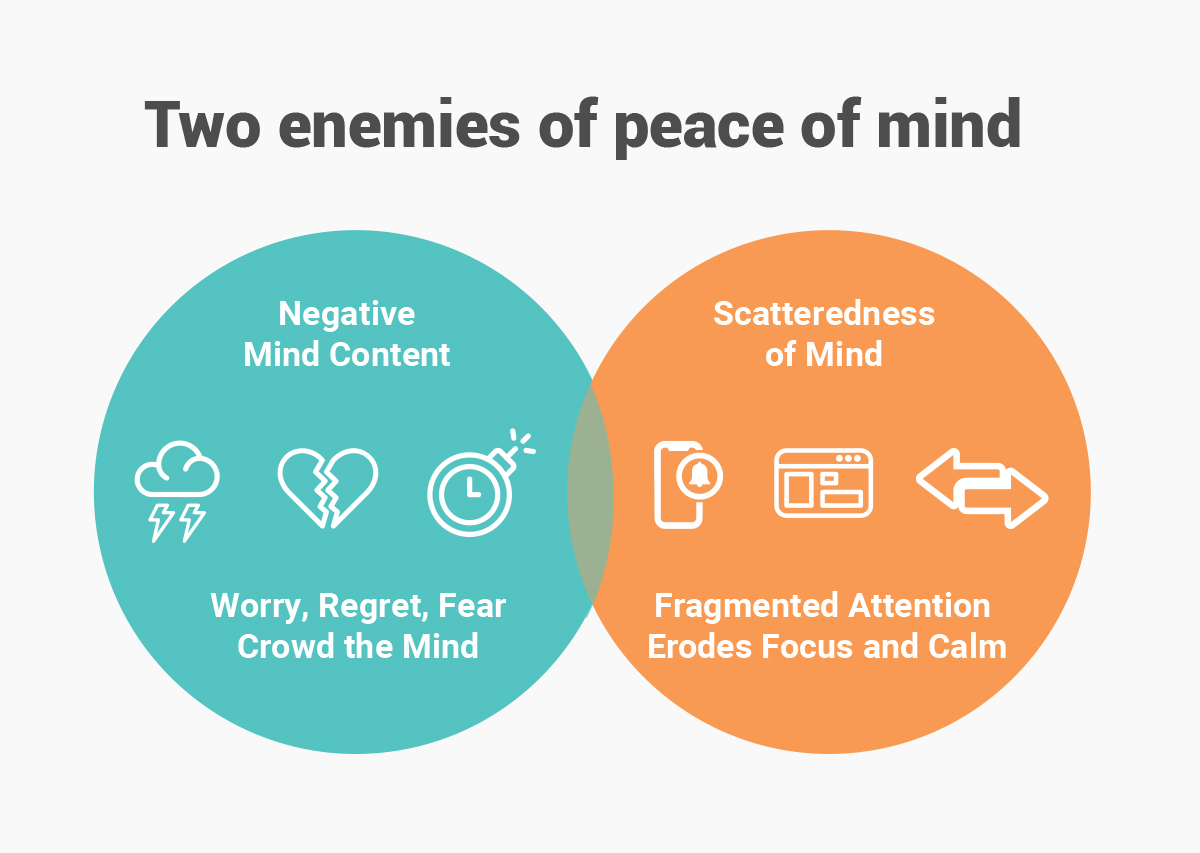
If we step back, we can see two distinct ways peace of mind is lost:
- Negative mind content – when thoughts and emotions turn toward worry, regret, or fear.
- Scatteredness of mind – when attention is fragmented, restless, and unable to settle.
Both are disruptive, but in different ways. One troubles us with what fills the mind. The other troubles us with how the mind operates. And increasingly, in the digital age, scatteredness has become the silent thief of peace.
Closing Reflection: A New Lens on Peace of Mind
For centuries, people have sought peace of mind by addressing the negative content of their thoughts. But in today’s world, it is no longer enough. Peace of mind also depends on protecting attention itself—reducing scatteredness, restoring focus, and creating the stability that calm requires.
This is only half the story. In the next piece, we’ll explore what happens when scatteredness and negativity collide—and why focused attention doesn’t just improve productivity, but brings a surprising sense of inner peace.