
The 80/20 Rule Can Help Clear the Noise for Your Consciousness
Have you ever ended the day drained—not from what you actually did, but from everything swirling in your head? Emails, errands, decisions, interruptions—the noise never stops. You’re busy, yet strangely unfulfilled, because effort no longer equals progress.
Clearing that noise takes more than awareness or another time-management trick. It requires a shift in consciousness—a way of seeing the world that separates the vital few from the trivial many.
That shift is the 80/20 Rule in action—one of the most powerful principles in focus, productivity, and time management.
What Is the 80/20 Rule?
At its core, the 80/20 Rule—also known as the Pareto Principle—reveals a striking truth: in almost every area of life, a small portion of inputs produces the majority of results. The numbers aren’t literal; they’re symbolic of a powerful imbalance.
Across business, health, and personal life, a minority of efforts, relationships, or decisions create most of the meaningful outcomes.
- In business, a small percentage of customers typically drives most of the revenue.
- In work, a handful of key tasks create most of your progress and peace of mind.
- In advertising, a small share of campaigns or messages generates most of the engagement
The 80/20 Rule is the math. An 80/20 consciousness is the mindset—the daily discipline of focusing your best energy on what truly moves the needle.
It’s not about doing more; it’s about doing more of what matters. By learning to spot the vital few amid the trivial many, you reclaim clarity, direction, and calm.
Watching the 80% Melt Away
The 80/20 Rule is one of the most liberating discoveries in all of time management. Once you grasp it, it can feel almost magical—like being handed a secret lever that multiplies time.
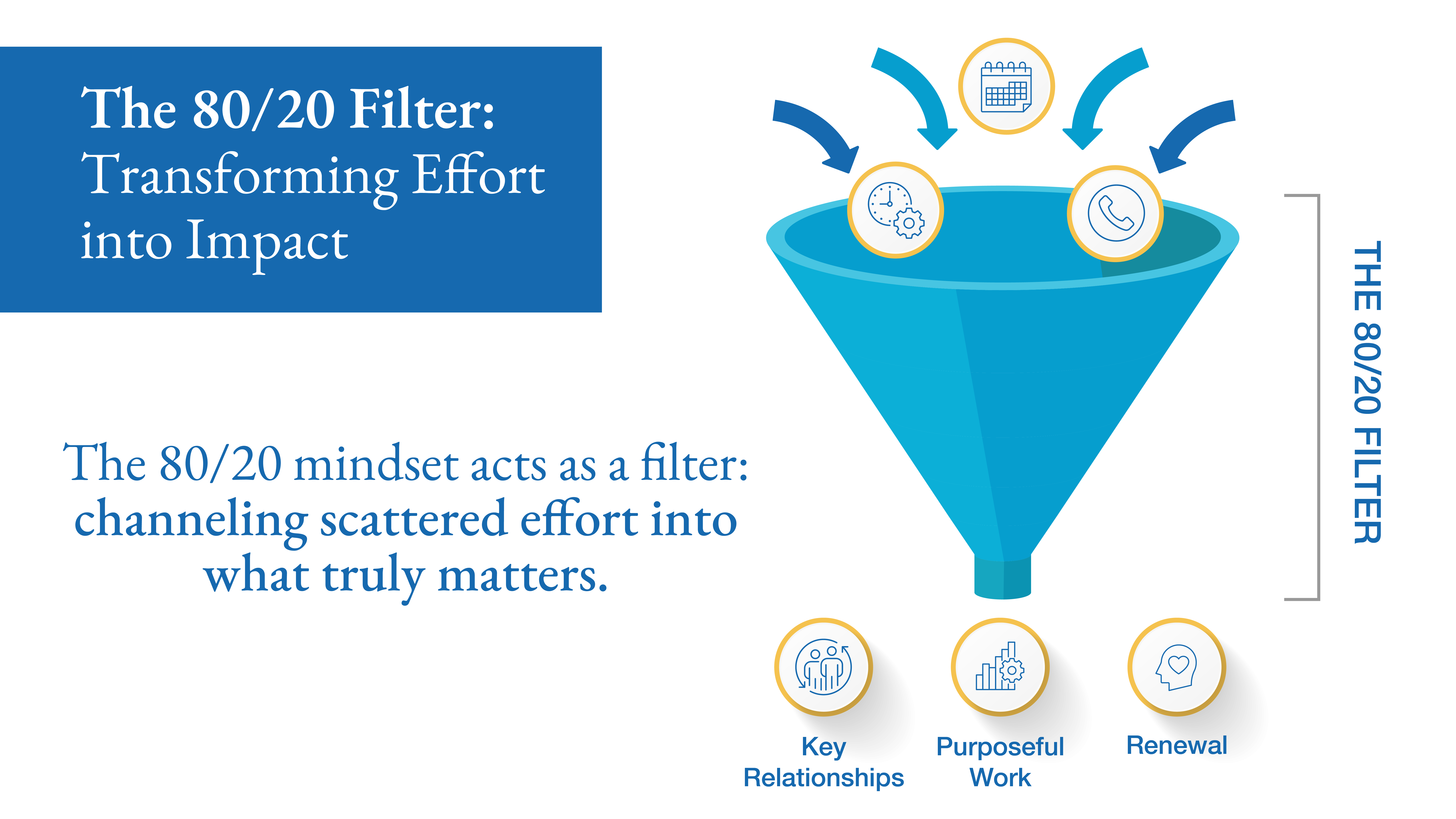
Imagine taking your endless scroll of tasks and feeding it into a brilliant machine. A moment later, the clutter vanishes—80 percent gone. No smoke, no illusion—just clarity. What’s left is the short list that truly matters: the vital few actions, relationships, and priorities that create nearly all of your results.
That’s the genius of the 80/20 Rule. It doesn’t ask you to do more—it helps you let go.
When you start applying it, you realize how much time, energy, and attention were quietly leaking into the trivial many—and how freeing it feels to reclaim them.
Why the Other 80% Melts Away
When you feel that lightness—the quiet after the noise—you start to wonder how it happens. How can focusing on a few key things make the rest seem to disappear?
The answer lies in a quiet chain reaction that unfolds inside both your mind and your day. Once you begin directing attention and energy toward the vital few, your perception, motivation, and environment start to reorganize themselves. Here’s how the process works:
1. Selective Attention
When you clarify what truly counts, your brain begins filtering the world through that lens. This natural mechanism—known as attentional bias—acts like a cognitive spotlight. You literally stop noticing many of the trivial tasks that once tugged at your focus.
2. Opportunity-Cost Awareness
As you experience the deeper satisfaction of progress on what matters, your brain rewires its reward system. The fleeting dopamine of box-checking gives way to the richer reward of meaningful traction.
3. Natural Attrition of Noise
The things you no longer feed begin to fade. Many “urgent” tasks quietly resolve themselves—someone else handles them, the need evaporates, or the moment simply passes. The illusion of necessity collapses under neglect.
4. Energy Reallocation
By protecting your top 20%, you build momentum there. That momentum compounds—creating progress, satisfaction, and results that make lower-value work redundant. Your best work begins doing the heavy lifting for you.
Living in the Vital 20%
80/20 consciousness isn’t a one-time trick—it’s a daily discipline that begins with one question:
“What few actions today will create the greatest impact?”
Each evening, identify your top priorities for tomorrow and schedule them—not just list them. That single step transforms good intentions into commitments that actually happen.
When those priorities are complete, resist the reflex to fill time with low-value tasks. Pause and ask yourself, “What is now my top 20%?”
Often, that shift leads you toward things that rarely make it to the top of a list—advancing a long-term project, strengthening a key relationship, or simply recharging so tomorrow begins with clarity instead of fatigue.
Done consistently, this simple rhythm changes everything. Focus compounds, momentum builds, and extra time turns from clutter into leverage—fuel for what truly matters.
The Quiet Power of 80/20 Consciousness
The 80/20 principle is the greatest law of time management because it turns effort into impact. When you live by it, your world simplifies: the noise quiets, and much of what once felt urgent either resolves, fades, or stops mattering altogether.
That’s the real gift of 80/20 consciousness: it doesn’t just make you productive—it makes you free. When you live in the vital 20%, life stops feeling like a race and starts feeling intentional—spacious, calm, and aligned with what matters most.