The Law of Moods and Timing in Communication
I want to tell you something that could change the way you communicate—and possibly cut half of your avoidable problems right out of your life. It’s a principle so simple, yet so overlooked, that most of us trip over it every day: the Law of Moods.
Here’s the truth: even the best words, spoken at the wrong time, will not land. The same phrase that feels caring in a calm state can feel like criticism in a low one. Timing in communication doesn’t just influence a conversation—it determines it.
Once you see this clearly, you’ll wonder how you ever missed it.
In the Heat of the Moment
Suppose you’ve just bought an expensive engraved vase for your wife’s birthday. Beaming with pride, you show it to your sons before carefully placing it on a high shelf in the living room, well out of reach. Then you head out to pick up flowers.
In your absence, the boys get into a wrestling match. One hurls a baseball a little too high, and the vase comes crashing down, shattering into pieces.
You return to find the vase broken, your kids terrified, and yourself flooded with anger. What do you do in that moment?
The Law of Moods and Emotional States
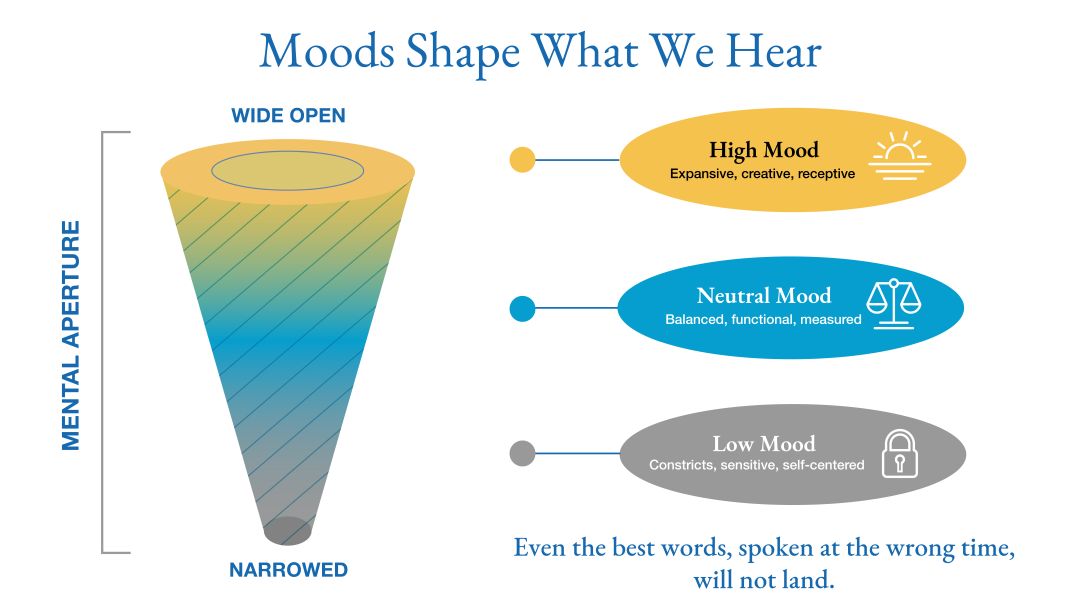
The Law of Moods recognizes that our thinking is highly colored by our emotions. We think best in a high mood and worst in a low one. Here, “mood” refers broadly to our emotional bandwidth, and it’s best understood as a continuum—from high to low—rather than a simple on/off switch.
Characteristics of These States:
- High moods open the aperture of our mental faculties. We feel creative, curious, and energized. We’re open-minded, graceful, and generous in spirit. Communication flows easily, and our perspective broadens.
- Intermediate moods keep us steady and functional. We can focus and get things done, with enough energy and connection to carry us through the day. These states feel neutral to mildly positive—neither expansive nor constricting.
- Low moods are the states where life feels tight and closed in. Our attention narrows, creativity quiets, and we become more sensitive and self-focused. What once bounced off us now stings, and our outlook tilts negative.
Timing Is Everything
Let me be blunt: this may be the single most important, and most ignored, rule of effective communication. If you follow it, you can dramatically reduce conflict, regret, and misunderstanding. If you ignore it, even the right words can blow up in your face.
The worst conversations happen when at least one person is in a low mood. That’s the recipe for spirals, fights, and lasting damage. Before you speak, check your own state and theirs. If either is low, wait. That pause alone can prevent months of fallout.
Why It’s So Hard
Of course, this is easier said than done. When we’re low, we don’t recognize how much our thinking is being distorted—we simply believe the thoughts in front of us.
In that state, two distortions collide:
- Problems feel bigger than they are. A small issue can suddenly look catastrophic.
- Patience shrinks. We feel an urgency to act right now, even though that urgency is mostly an illusion.
It’s a dangerous mix: exaggerated problems paired with diminished patience. This is exactly the recipe for saying things we later regret.
To make matters harder, venting often feels good in the moment.
Together, these forces explain why low moods so often become the setting for big conversations—about relationships, discipline, or decisions—and why those conversations so often go badly.
Coming Back to the Boys
So back to the broken vase. In that moment, anger floods you and your kids freeze with fear. If you scold or discipline right then, your words won’t teach—they’ll wound.
But if you wait until the next morning, when everyone’s calmer, the same words can land with wisdom instead of heat. That single act of restraint can mean the difference between fear and trust, shame and learning.
Why This Law May Change Your Life
Let me emphasize this point, because it deserves it: the Law of Moods is one of the most transformative principles you can live by.
Think about it: how many fights in your closest relationships, how many regrets with your kids, how many friendships strained—all because you spoke in a low state or chose the wrong moment?
When we act in a low mood, we can plant days—even months—of resentment in a single hour. But when we learn to pause, notice, and wait, we unlock a different life: calmer, wiser, and dramatically freer of unnecessary conflict.
This is why the Law of Moods matters. It’s not just about what you say. It’s about being wise enough to know when to say it. Master this, and you’ll never look at your conversations—or your relationships—the same way again.