
From Correlation to Explanation
In my last blog, I introduced the idea that social connectivity is one of the most overlooked determinants of health. We saw that loneliness and weak social ties are not just emotionally painful, but strongly linked to chronic disease and premature mortality.
The natural question that follows is: why? What are the underlying mechanisms that make the absence of connection so harmful, and the presence of it so protective?
Why loneliness hurts so deeply
Loneliness feels painful because it strikes something fundamental in us: the drive for connection. Disconnection isn’t just missing company; it reflects a deeper truth—that our souls are attuned to bond with others.
Just as important is our need to contribute—to give, to care, and to make a difference in others’ lives. Much of our fulfillment comes from knowing we matter, that our presence adds value beyond ourselves.
As our bodies ache when deprived of food or rest, our inner life aches when deprived of bonds and the chance to give of ourselves. This helps explain why loneliness is universal: it signals that something vital to our essence is missing—both connection and contribution.
Two Sides of Disconnection
It helps to distinguish between loneliness and weak ties. They are closely related and often overlap, but they aren’t identical.
- Loneliness is the subjective feeling of disconnection. It tends to act as an immediate stressor, triggering biological stress responses and shaping mood, emotions, and mental health.
- Weak ties or small networks are the objective reality of having fewer relationships and connections. In part they matter because they may tend to reduce access to support, advice, accountability, and shared activity—factors that also shape behavior and long-term health.
In practice, both forces often reinforce one another. The sharp sting of loneliness combines with the slower drain of limited social resources, compounding health risks.
Direct Biological Pathways
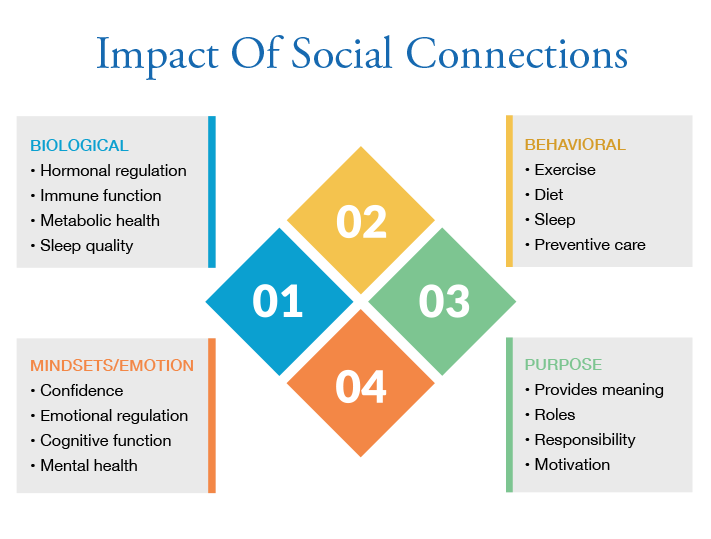
Disconnection doesn’t just affect how we feel—it leaves fingerprints on the body itself. Research shows that loneliness and weak social ties can set in motion biological changes that, over time, erode health.
Some of the most well-documented effects include:
- Stress hormones that stay elevated too long
- An immune system stuck in overdrive, fueling inflammation
- Disrupted blood sugar and metabolism, raising diabetes risk
- Fragmented sleep with less deep, restorative rest
- Greater risk of memory problems and cognitive decline
Layered together, these changes wear down the body’s defenses and make chronic disease more likely.
Behavioral Pathways
Disconnection doesn’t just harm the body directly—it also changes how we live. Strong evidence shows that people who are lonely or socially disconnected are more likely to skip exercise, eat poorly, or delay medical care.
They are also more prone to unhealthy coping—smoking, drinking, or excess screen time—as substitutes for connection.
When these habits stack on top of chronic stress, the harm compounds, accelerating sarcopenia (the age-related loss of muscle and strength), increasing frailty, and steadily eroding resilience with age.
Emotional & Cognitive Mechanisms
Loneliness doesn’t just change behavior; it changes how we think and feel. Isolated individuals become more prone to cycles of worry, self-doubt, and pessimism, which fuel stress and make recovery harder.
Research confirms this. Large studies show that loneliness is one of the strongest predictors of depression, and it also raises the risk of anxiety.
Once these take hold, the cycle of loneliness and emotional distress often feeds on itself, making both mental and physical health worse.
Purpose and Meaning as a Protective Factor
Connection doesn’t just buffer stress or improve habits—it also gives life meaning. Belonging provides us with roles, responsibilities, and contributions that matter.
When we know others rely on us, we gain a sense of significance and purpose.
Loneliness and social isolation erode these anchors. Disconnected people often feel adrift, struggle to stay motivated, or question whether their lives matter. Without social affirmation, it becomes harder to sustain a sense of meaning.
The Synergy of Mechanisms
These mechanisms—stress biology, daily behaviors, emotional patterns, and sense of meaning—rarely act alone. They reinforce one another.
Chronic loneliness is not just unpleasant; it sets off a cascade, a “perfect storm” of biological wear and tear, unhealthy behavior, and emotional depletion.
And when loneliness is combined with weak networks, the risks intensify. The immediate stress of feeling isolated interacts with the long-term disadvantages of having fewer resources, producing a compounded impact on health and mortality.
Practical Takeaway: Why This Matters for You
Understanding the why behind the science makes one thing clear: social connection is not just in your head. It is biologically protective. Weak ties and close ties alike can literally shape your health trajectory.
But if connection is so essential, another question arises: why is it so difficult for many of us to sustain? If relationships are as vital as nutrition or exercise, what holds us back from cultivating them as faithfully as we do other aspects of health?
That is where we’ll turn next: the obstacles, old and new, that quietly erode our ties. Only by naming them can we begin to reclaim the full power of connection.