
What Science Reveals About the Health Benefits of a Purposeful Life
What makes a person “tick”? For centuries, philosophers, psychologists, and spiritual teachers have sought to answer this question. But the answer isn’t just spiritual or philosophical: its profoundly biological. Human beings have a fundamental, measurable need for purpose and meaning.
Purpose is a core psychological need, as essential to well-being as food and water are to physical survival.
We’re all attuned to basic physical needs: hunger, thirst, sleep. When those go unmet, the body sends unmistakable signals—fatigue, discomfort, even alarm. But psychological needs are just as real, even if their signals are subtler and easier to overlook. And among these psychological needs, the need for purposeful living stands out.
When this need is met, it fuels a sense of vitality—an inner aliveness, drive, and engagement with life. But when it’s missing, something feels off. People may experience restlessness, tension, or a vague emptiness. These symptoms are often mistaken for burnout, physical discomfort, or depression—when in fact, they may stem from a deeper loss of life direction.
Viktor Frankl and the Survival Power of Purpose
Few captured this truth more powerfully than Viktor Frankl, the Austrian psychiatrist and Holocaust survivor. In Man’s Search for Meaning, he described how those who held onto a sense of purpose—through love, belief, or responsibility—were more likely to survive the concentration camps.
His experience echoed Nietzsche’s famous words: “He who has a why to live can bear almost any how.”
Why Purpose Was Long Overlooked in Health Research
While purpose is now recognized as a powerful source of resilience, it was long overlooked as a distinct health domain. When behavioral medicine took shape in the late 1970s—with the founding of the Society of Behavioral Medicine in 1978—research over the following decades focused largely on depression, anxiety, anger and hostility, social isolation, and chronic stress.
At the time, there was little evidence linking life purpose to concrete health outcomes like heart disease or longevity. Thus, it did not receive much attention in the medical community. It was often viewed as too abstract or subjective to study vigorously.
A Turning Point: The Health Consequences of a Lost Sense of Purpose
That began to change in the early 2000s, when researchers began investigating how a sense of purpose affects physical health. One early and striking example came from the MacArthur Study of Successful Aging, which followed 1,189 older adults (1). When asked, “How often do you feel useful to your friends or family?”, those who reported low feelings of usefulness had a 75% greater risk of dying over the next nine years compared to those who felt useful.
The Evidence Grows: Purpose Protects the Body
Building on such findings, our team conducted a meta-analysis of 11 longitudinal studies (2). The results were clear: individuals with a higher sense of purpose had significantly lower risk for cardiovascular events and all-cause mortality. In other words, life purpose isn’t just psychologically protective—it’s physiologically protective.
Since then, the evidence has expanded. A higher sense of purpose has also been linked to lower risk of: stroke, cognitive decline, sleep disturbances, disability in daily living, and depression and anxiety ().
Why Purpose Affects Health: The Mechanisms at Work
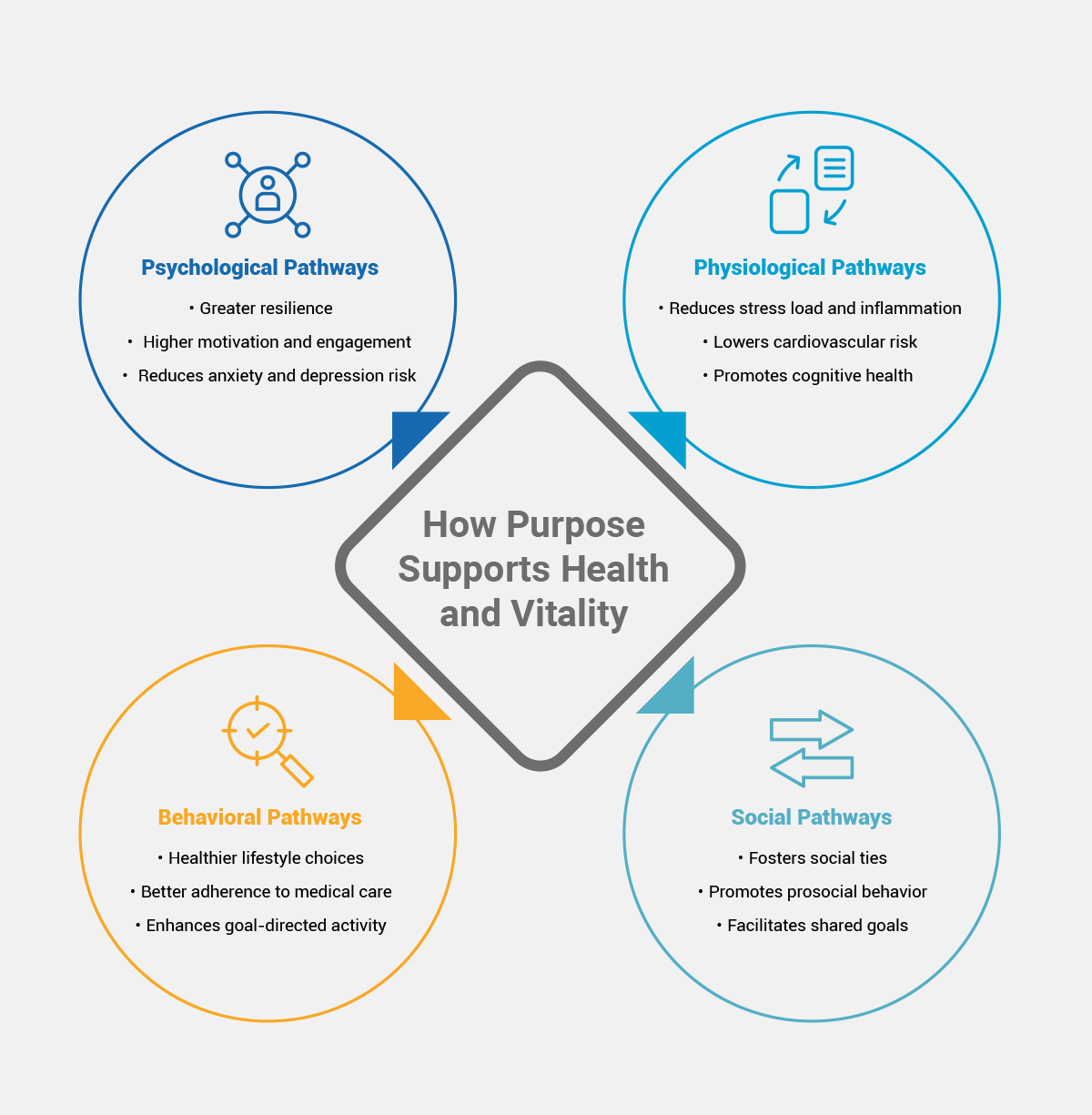
Several biological, behavioral, and psychosocial mechanisms likely underlie these links. People with a strong sense of purpose tend to lead healthier lives, with lower inflammation and stress hormone levels, and greater emotional resilience. Purpose may even influence gene expression related to immune function and aging.
These findings have sparked a shift in how we view purpose—not as a luxury, but as a powerful determinant of long-term health and vitality. Viewed this way, purpose is no longer a lofty aspiration but a measurable contributor to vitality—and one well worth developing.
Beyond the Data: The Challenge—and the Promise—of Purpose
The good news is that purpose is not fixed. It’s a modifiable trait—something that can be cultivated and strengthened at any age. Unlike our genetics or early-life experiences, purpose can grow with reflection, effort, and intention. That makes it one of the most hopeful levers for improving both health and fulfillment.
What’s Next: Finding Your “Why” in Everyday Life
The good news is that purpose is not fixed. It’s a modifiable trait—something that can be cultivated and strengthened at any age. Unlike our genetics or early-life experiences, purpose can grow with reflection, effort, and intention. That makes it one of the most hopeful and empowering levers for improving both health and fulfillment.
In the posts ahead, we’ll move from “why” purpose matters to “how” to cultivate it. We’ll look at the common barriers that get in the way and explore practical, evidence-based ways to reconnect with the pursuits that make us feel most alive. Our next post will unpack four core qualities that define purposeful living—and how to begin developing them in everyday life.
Because purpose isn’t just about having a reason to get up in the morning.
It’s about awakening each day with a sense of direction—and feeling fully alive when you do.
REFERENCES
- Gruenewald TL, Karlamangla AS, Greendale GA, Singer BH, Seeman TE. Feelings of usefulness to others, disability, and mortality in older adults: The MacArthur Study of Successful Aging. Journal of Gerontology: Psychological Sciences. 2007;62B(1):P28–P37.
- Kim ES, Sun JK, Park N, Kubzansky LD, Peterson C. Purpose in life and reduced risk of myocardial infarction among older U.S. adults with coronary heart disease: A two-year follow-up. Circulation. 2013;127:1492–1498.
- Cohen R, Bavishi C, Rozanski A. Purpose in life and its relationship to all-cause mortality and cardiovascular events: A meta-analysis of prospective studies. Psychosomatic Medicine. 2016; 78:122–133.