
Life Purpose Can Protect Us from the Health Impacts of Loneliness
The sting of loneliness—and the health toll of thin social networks and weak social ties—has been highlighted in both recent research and in my earlier blogs on social connectivity. Both are linked to biological wear and tear, reduced mental well-being, and a lower capacity for resilience. They can weigh heavily on body and mind.
But not everyone relates to these experiences in the same way. There are seasons in life, sometimes even long stretches, when thin or fragile ties don’t feel as pressing. Why is that?
Why Purpose Matters More Than We Realize
The answer is that even stronger than our need for relatedness to others is our need to live with purpose. A deep sense of direction, contribution, or calling can act as a higher organizing force, giving life meaning even when connection feels scarce.
A strong sense of life purpose supplies a reason to get up in the morning, a source of resilience in adversity, and a framework for identity. When purpose is strong enough, it can quiet—or even eclipse—the ache for more social bonds.
Jonas Salk: Purpose Above Social Life
We often see people willing to sublimate their need for relatedness in pursuit of a higher calling. Jonas Salk is one striking example. In the early 1950s, as polio raged through communities, the disease left thousands of children paralyzed each summer and terrified families across the world.
At the University of Pittsburgh, Salk labored sixteen hours per day, seven days a week, for years as he worked on developing a potential vaccine. His devotion to the mission eclipsed the normal rhythms of social life during that period of his life.
What drove him was not comfort or companionship, but an unshakable commitment to saving humanity from a devastating disease.
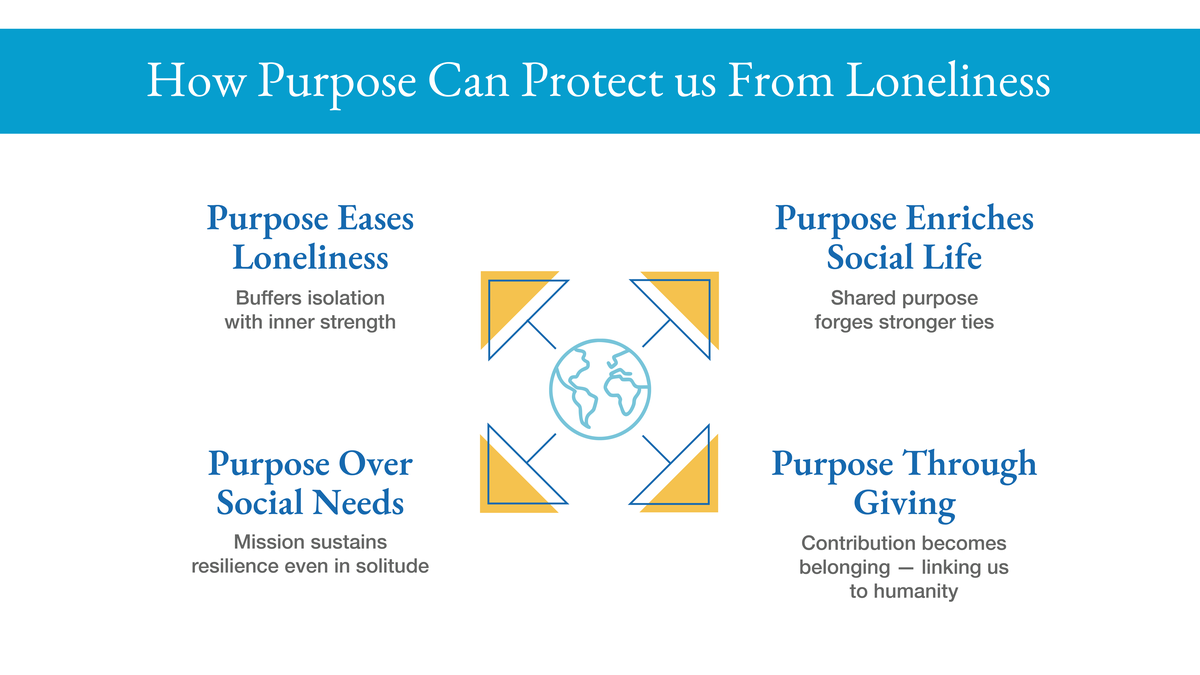
How Life Purpose Reshapes Loneliness and Connection
Salk’s dedication is beyond the ordinary but far from rare. We can all think of people who have at times sublimated parts of their social life for the sake of pursuing a cause they fervently believe in—whether that’s an artist pouring into their craft, a parent fighting for a child’s well-being, or a community leader championing change.
What these examples show is that when life purpose is deeply felt, it changes our relationship with connection. Sometimes it softens the sting of loneliness, sometimes it eclipses the need for it, and often it reshapes our relationships in empowering ways.
Four Ways Purpose Interacts With Connection
This doesn’t mean that purpose makes relationships unimportant. Rather, it alters how we experience them. For most of us, purpose and connection are not rivals but companions—interacting in different ways depending on the season of life. Here are three patterns that emerge:
1. Purpose Softens the Sting of Loneliness
When life is anchored in meaning, the toll of thinner ties doesn’t weigh as heavily. Purpose provides an inner ballast, buffering the biological stress of isolation and supporting mental well-being.
We may still notice loneliness, but it no longer defines us—and research suggests that people with a stronger sense of purpose in life report fewer negative effects of loneliness and isolation.
2. Purpose Can Trump Social Needs (for Some People)
For certain individuals, the pull of purpose sits even higher than belonging in their hierarchy of needs. Artists, activists, and innovators often channel their energy into their mission, sometimes at the expense of typical social rhythms.
Yet their sense of direction sustains resilience, protecting them from some of the vulnerabilities that come with isolation.
3. Purpose Can Empower a Richer Social Life
Paradoxically, purpose can be the very thing that fosters stronger ties. Living with conviction attracts like-minded people and reshapes relationships around shared values. In fact, a clear life purpose often strengthens social networks by drawing others with shared values.
It also shifts the orientation of our connections: instead of grasping for affirmation, we bring contribution. That stance often forges more authentic, empowering bonds that themselves reinforce vitality and resilience.
4. Purpose as Connection Through Giving
Even when social ties are thin, purpose can create a felt sense of connection by linking us to something larger than ourselves. Contribution is its own form of belonging. Jonas Salk, for example, may not have felt socially isolated during his long hours in the lab because through his work he was giving to humanity.
In this sense, purpose itself becomes a bridge: by giving, we remain connected—to the world, to the future, and to the lives we hope to impact.

Living With Purpose to Build Resilience and Vitality
Purpose and connection are not rivals but partners. Relationships give us belonging; purpose gives us direction. Together, they form twin foundations of vitality.
Even when close ties are scarce, purpose can still tether us to the world. By giving of ourselves—to a cause, a craft, or a community—we can remain connected, even in solitude. Jonas Salk’s lab work was not just an isolated pursuit; it was a form of contribution that bound him to humanity’s future.
This is the deeper promise of purpose: it doesn’t merely soften loneliness or empower social life, it creates connection in its own right. Every act of service, every commitment to something larger, affirms that we belong to the fabric of life.